Hotel Staff Task Management Software: 2026 Buyer Guide
Hotel staff task management software gives independent hotels and short-term rentals one shared system for logging, routing and tracking every guest request and internal chore, replacing sticky notes, radios and scattered text threads. For a boutique property running on a lean team, that single change often decides whether a guest's stay feels effortless or frustrating. Below, you'll find a complete breakdown of what this software category actually does, which features are worth paying for, how it compares with broader hospitality workforce management platforms, and how a lightweight, no-integration approach like Cortesia stacks up against heavier enterprise tools.
Direct answer: Hotel staff task management software is a digital hub where guest requests and staff chores are captured, assigned to the right department, and tracked through to completion. The strongest options for independent hotels require no PMS integration, support multiple guest languages, and go live in days rather than months, unlike broader workforce management platforms, which focus on scheduling and payroll instead of day-to-day task tracking.
What Is Hotel Staff Task Management Software?
Hotel staff task management software is a system that turns a guest's request, or an internal chore, into a tracked task with an owner and a status. Instead of a front-desk agent scribbling a note for housekeeping, the request lands directly on a dashboard that everyone on shift can see.
In practice, this covers three things at once: capturing the request, routing it to the correct department, and recording when it was resolved. Consequently, a general manager can see at a glance whether the 2 PM room-cleaning request actually happened, instead of hoping it did.
For boutique hotels specifically, this software often doubles as the guest-facing concierge, too. A guest scans a QR code, asks a question in their own language, and the answer or task appears on the staff side already translated. This differs from a call center; there is no hold music, no shared front-desk phone line, and no guesswork about who is handling what.
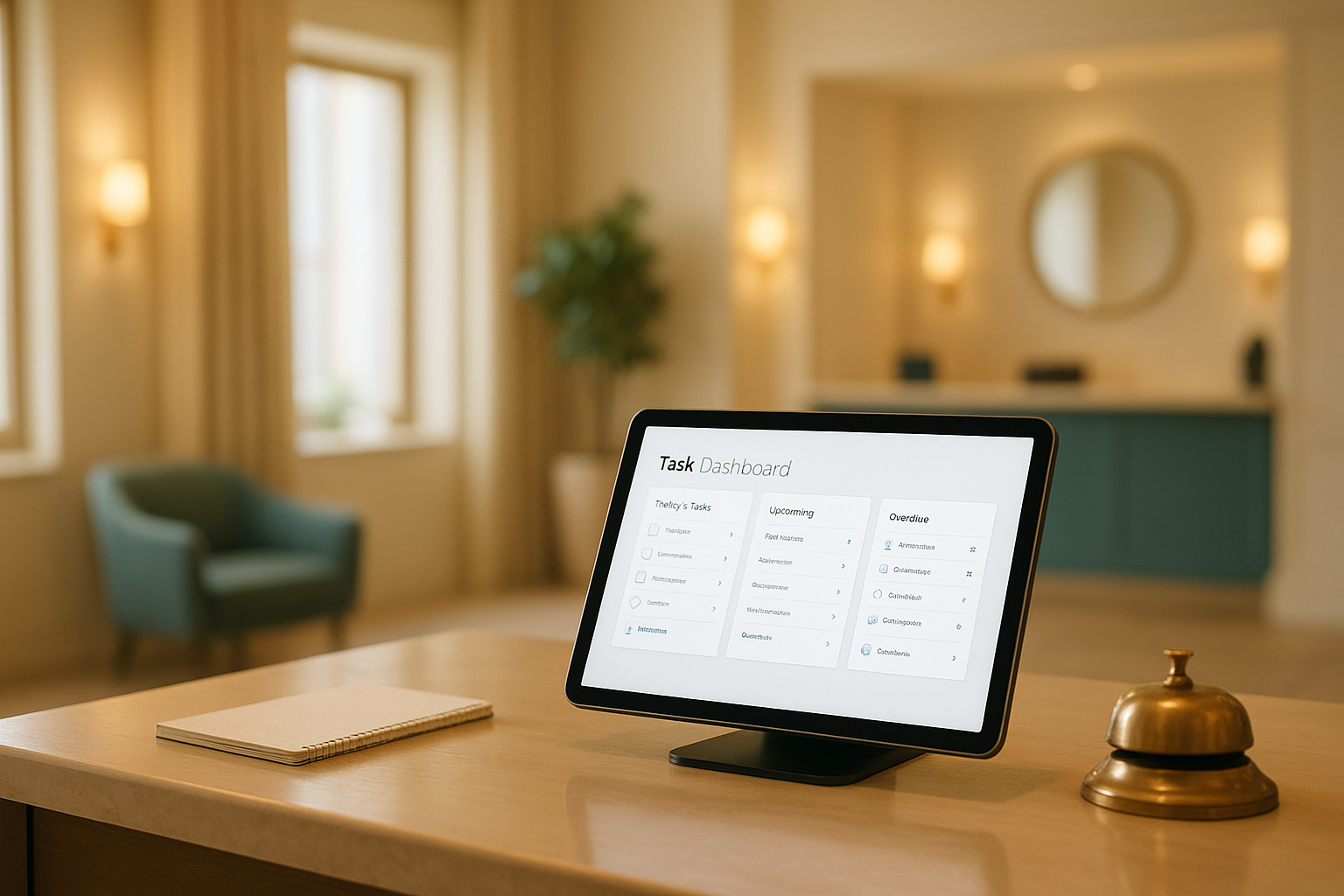
A live dashboard is the core of most hotel staff task management software.
Hotel Staff Task Management Software vs. Hotel Workforce Management Software
These two categories are often confused, which is understandable since both aim to help hotels run with fewer people doing more. However, they solve different problems. Hotel workforce management software, sometimes called labor management software, focuses on scheduling shifts, forecasting labor demand, tracking time and attendance, and feeding hours into payroll. In contrast, hotel staff task management software focuses on what happens during a shift: who does what, when, and whether it got done.
Put simply, workforce management answers "who is working today and what will it cost?" while task management answers "is the guest in room 204 still waiting for extra towels?" Many independent hotels eventually want both, but they rarely need both on day one. For a lean team drowning in guest requests, task management typically delivers faster, more visible relief.
Category | Hotel Staff Task Management Software | Hotel Workforce Management Software |
|---|---|---|
Primary purpose | Capture, route and track guest requests and chores | Schedule shifts, forecast labor, manage payroll hours |
Guest-facing? | Usually yes, via QR code or link | No, internal only |
Typical setup time | Days, especially without a PMS integration | Weeks to months, often tied to payroll setup |
Best for | Independent hotels and short-term rentals needing fast, visible service | Properties managing complex, multi-department labor budgets |
Why Boutique Hotels Need Guest Request Management Now
Staffing pressure is not a temporary blip. An AHLA and Hireology survey found that 65% of hotels report staffing shortages, with housekeeping (38%) and the front desk (26%) named as the most critical gaps, according to the American Hotel & Lodging Association. Fewer people are covering the same number of rooms and the same volume of questions.
At the same time, international travel has fully recovered, with roughly 1.5 billion international arrivals recorded globally according to data tracked by the UN Tourism organization (UNWTO). As a result, more guests at independent properties speak a language other than the one the front desk speaks. Research from CSA Research shows 76% of consumers prefer to engage in their own language, which means a language barrier is not a minor inconvenience; it is a service failure waiting to happen.
In short, staff communication tools that once felt optional now sit closer to essential. A property that still relies on radios and paper logs is asking a smaller team to do more with worse visibility, which is exactly the gap hotel staff task management software is built to close.
Core Features of Hotel Staff Task Management Software
Not every platform in this space is built for a 40-room hotel. Before comparing vendors, it helps to know which features actually move the needle for a lean, independent team.
No-app guest access. A QR code or link a guest can use immediately, without downloading anything or creating an account.
Automatic routing. Requests should land with housekeeping, maintenance or the front desk without a human sorting them first.
Multilingual support. Translation on both sides of the conversation, so the guest and the staff each read their own language.
Safety alerts. Allergy or accessibility mentions should trigger a required acknowledgment, not just a flag that can be missed.
Live reporting. Managers need visibility into open tasks, average response time, and which department is falling behind, in real time.
Escalation rules. A task sitting untouched for too long should automatically notify a supervisor rather than quietly aging in a queue.
Maintenance and out-of-order tracking. Rooms taken offline for repairs need their own visible status; see this guide on tracking out-of-order rooms for a closer look at that workflow.
Simple pricing. Per-room, month-to-month plans fit an independent hotel's cash flow better than per-seat enterprise contracts.
Above all, the software should reduce friction rather than add a new system for staff to learn on top of everything else they already manage.
How Hotel Staff Task Management Software Works, Step by Step
Most platforms follow a similar sequence from the moment a guest speaks up to the moment the task is closed. Here is the typical flow:
Guest submits a request. The guest scans a printed QR code in the room or unit and types or speaks a request in their own language, with no app download and no login required.
System translates and categorizes it. The software translates the message into the language staff use and tags it as housekeeping, maintenance, or front desk automatically.
Task routes to the right department. The categorized request appears instantly on the live staff dashboard, assigned to whoever is responsible, instead of waiting for a radio call.
Staff acknowledges and resolves it. A team member marks the task received, completes the work, and updates its status, which creates a timestamped record of exactly when it closed.
Manager reviews patterns. Managers check completed and pending tasks, confirm safety alerts were acknowledged, and coach staff on slow response times.
Because none of this depends on a PMS integration in tools like Cortesia, properties can go from signing up to live requests in days rather than months. This same flow also replaces the back-and-forth of scattered guest texts; for teams still juggling multiple inboxes, this breakdown of how to organize guest requests fast explains why a single dashboard beats a dozen text threads.
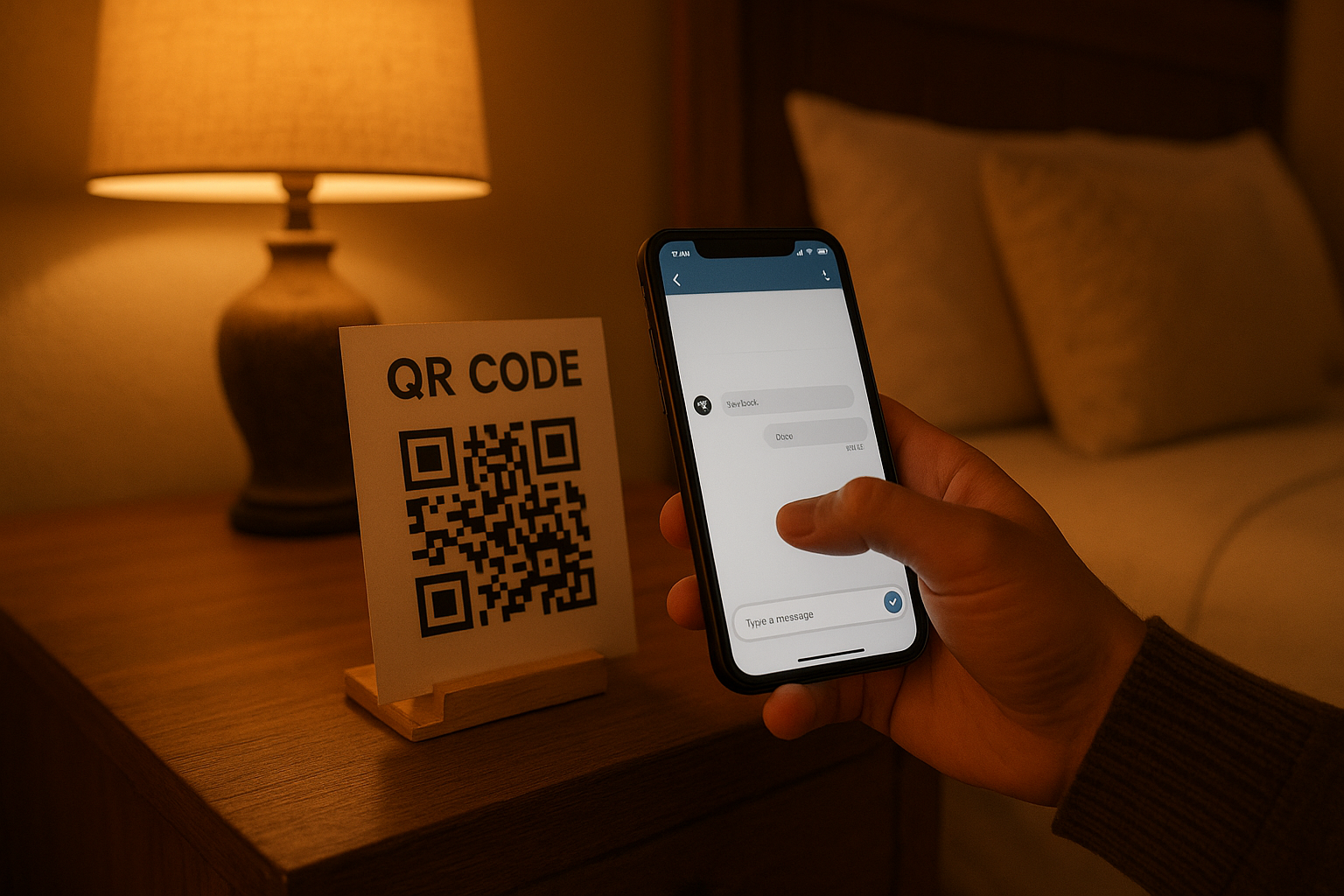
No app, no login: the guest side of hotel staff task management software should feel instant.
Hotel Task Management Software vs. Traditional Methods
Radios, paper logs and sticky notes still run plenty of independent hotels. However, each of these methods loses information the moment a shift changes. A note left on a desk does not update itself when the task is done, and a radio call is only as reliable as whoever is listening.
By contrast, a shared digital system keeps one version of the truth. Everyone, from the overnight front-desk agent to the morning housekeeping supervisor, looks at the same list of open and closed tasks. In addition, a digital record makes it possible to prove that a guest's allergy note was actually seen by the kitchen, not just mentioned once and forgotten.
The trade-off is cost and setup time. Traditional methods are free and require no training, while software has a monthly fee and a short onboarding period. For most properties with more than a handful of rooms, though, the time saved and the mistakes avoided make that trade worthwhile.
Measuring ROI: KPIs That Prove Hotel Staff Task Management Software Is Working
A tool is only worth its monthly fee if it actually changes outcomes. Therefore, before rolling anything out, decide which numbers will prove it is working. Most properties track a short list of metrics:
Average response time. How long between a request landing and a staff member acknowledging it.
Task completion rate. The share of requests closed within a target window, such as 30 minutes for housekeeping items.
Safety alert acknowledgment rate. What percentage of allergy or accessibility flags get a confirmed read, ideally 100%.
Guest satisfaction and review scores. Faster, more visible service tends to show up directly in post-stay reviews.
Staff hours saved. Fewer radio calls and fewer "did anyone see this?" conversations translate into real time back in a lean team's day.
Consequently, a property that tracks these numbers from week one can prove the software's value to ownership quickly, rather than relying on anecdotal feedback alone.
Choosing the Right Staff Communication Tool for Your Property
Independent hotels and short-term rental operators do not need the same platform a 300-room chain uses. In fact, choosing an enterprise-grade tool built around a PMS integration can slow a small property down for months before it sees any benefit.
Instead, look for platforms sized to the property: unlimited staff seats rather than per-user fees, unlimited guest usage, and pricing based on room count. Cortesia, for example, uses simple per-room, month-to-month pricing with onboarding included and data exportable on request, which suits a 10 to 150-room boutique hotel far better than a seat-based enterprise contract.
It is also worth comparing how different platforms are positioned. Detailed side-by-side breakdowns, such as Cortesia vs. Bellboy, Cortesia vs. GuestAI, Cortesia vs. Canary Technologies, and Cortesia vs. Cloudbeds, show where each tool leans toward chains versus independents.
How Cortesia Approaches Hotel Staff Task Coordination
Cortesia is built specifically around the no-integration, no-app model described above. Guests scan a room QR code and get answers, service and local knowledge in one of eight supported languages, including full right-to-left Arabic, without downloading anything or creating an account.
Every request lands on one live staff dashboard, translated into the language the team works in, so a front-desk agent in Texas can serve a guest writing in Japanese without a translation app on the side. Food-allergy mentions trigger staff alerts that require acknowledgment, which closes a common gap between what a guest says and what the kitchen actually knows.
Setup includes building the property knowledge base, importing rooms and staff, and printing QR materials, and because there is no PMS integration to schedule, properties typically go live in days. The same model works for short-term rentals with no front desk at all; the Henderson House demo, a single Dallas rental, shows how one owner manages guest requests from a single dashboard. Readers curious about a live example can explore the Cortesia demo directly.
Common Mistakes When Rolling Out Hotel Task Management Software
Even a good tool can underperform if it is introduced poorly. The most frequent mistake is choosing a platform built for large chains, which usually assumes a PMS integration and a multi-month implementation project. That approach rarely fits a 40-room hotel with a small operations team.
A second mistake is skipping staff buy-in. If housekeeping and the front desk are not shown, in plain terms, how a task shows up and how to mark it done, adoption stalls within the first week. Short, role-specific training on a real shift solves this quickly, and timing it around a team-building moment, such as the ideas in this housekeeping week celebration guide, can turn training into something staff actually look forward to.
Finally, some properties treat safety alerts as optional. Allergy and accessibility notes need a required acknowledgment step, a practice broadly consistent with workplace safety communication standards outlined by the Occupational Safety and Health Administration; otherwise, they are just another message that can get lost in a busy shift, which defeats the purpose of adopting the software in the first place.
Rollout Checklist for a Smooth Launch
For teams that want a repeatable process instead of a one-off training session, these are the steps most successful rollouts share:
Build the property knowledge base before launch, so common guest questions already have accurate answers.
Import rooms and staff roles first, then test the full request-to-resolution flow with a fake guest request.
Print and place QR codes where guests will actually see them, not just at the front desk.
Run a short, department-specific walkthrough rather than one long all-staff meeting.
Review the dashboard daily for the first two weeks, which is also a good moment to revisit lessons from past rollouts, including these housekeeping week lessons for boutique hotels.
Frequently Asked Questions About Hotel Staff Task Management Software
What is hotel staff task management software?
Hotel staff task management software is a digital system that captures guest requests and internal chores, then routes each one to the right department and tracks it until it is done. It replaces radios, sticky notes and scattered texts with one shared record.
How does hotel staff task management software differ from a hotel PMS?
A property management system (PMS) handles reservations, billing and room status, while task management software focuses on day-to-day guest requests and staff communication. Many task platforms, including Cortesia, work well without a PMS integration at all.
How does hotel staff task management software differ from hotel workforce management software?
Workforce management software schedules shifts, forecasts labor needs, and feeds hours into payroll. Task management software, by contrast, tracks the actual guest requests and chores that happen during those shifts, including who handled them and how fast.
How much does hotel staff task management software cost?
Pricing varies widely, but tools built for independent hotels are often priced per room, per month, rather than per user. Cortesia, for example, uses simple per-room pricing with unlimited staff seats and guest usage.
How long does it take to set up task management software in a hotel?
Lightweight, non-integrated platforms can go live in days because there is no PMS project to manage. Setup typically involves loading the property knowledge base, importing rooms and staff, and printing QR materials.
Can small boutique hotels use hotel staff task management software without IT staff?
Yes. Tools built for independent properties are designed for owner-operators and lean teams, not IT departments. Onboarding is usually guided, and no server or app installation is required.
Does hotel staff task management software work for short-term rentals?
Yes, several platforms support single-unit rentals and small portfolios managed remotely. The same QR-code request flow that works in a hotel room works just as well at a rental's front door.
What is the biggest mistake hotels make when adopting task management software?
The most common mistake is choosing a platform built for large chains, which usually requires a PMS integration and a long rollout. Independent properties do better with lightweight tools that launch in days.
How does language translation work inside hotel task management platforms?
Better platforms translate the guest's request into the language staff use on the dashboard, and translate the staff reply back into the guest's language automatically. This removes the guesswork from multilingual service.
What features should independent hotels prioritize when comparing options?
Look for no-app guest access, automatic routing by department, multilingual support, allergy or safety alerts, live reporting, and simple month-to-month pricing. Avoid tools that force a lengthy PMS integration before launch.
Is hotel staff task management software the same as a guest messaging app?
They overlap but are not identical. Guest messaging focuses on the conversation, while task management software also tracks who is responsible for a request, its status, and whether it was completed on time.
How does task management software handle food allergies and safety alerts?
Leading platforms flag safety-sensitive mentions, such as food allergies, and require a staff member to acknowledge the alert before it can be closed. This creates a record of who knew and when.
What is the best practice for training staff on new task management tools?
Start with a short live walkthrough for each department, then let staff practice on real guest scenarios during a quiet shift. Most no-app platforms need under an hour of training because the dashboard mirrors how staff already work.
Does hotel staff task management software require a PMS integration?
No, not always. Some platforms are built to run entirely independently of the PMS, which is what lets a boutique property go live in days instead of months.
What ROI can hotels expect from hotel staff task management software?
Most properties see faster response times, fewer missed requests, and improved guest review scores within the first few weeks. Tracking completion rate and response time from day one makes the return easy to document.
Can hotel staff task management software help track out-of-order rooms and maintenance issues?
Yes. Maintenance issues can be logged as tasks with a status, so front desk and housekeeping both know a room is unavailable without relying on a whiteboard or a verbal handoff between shifts.
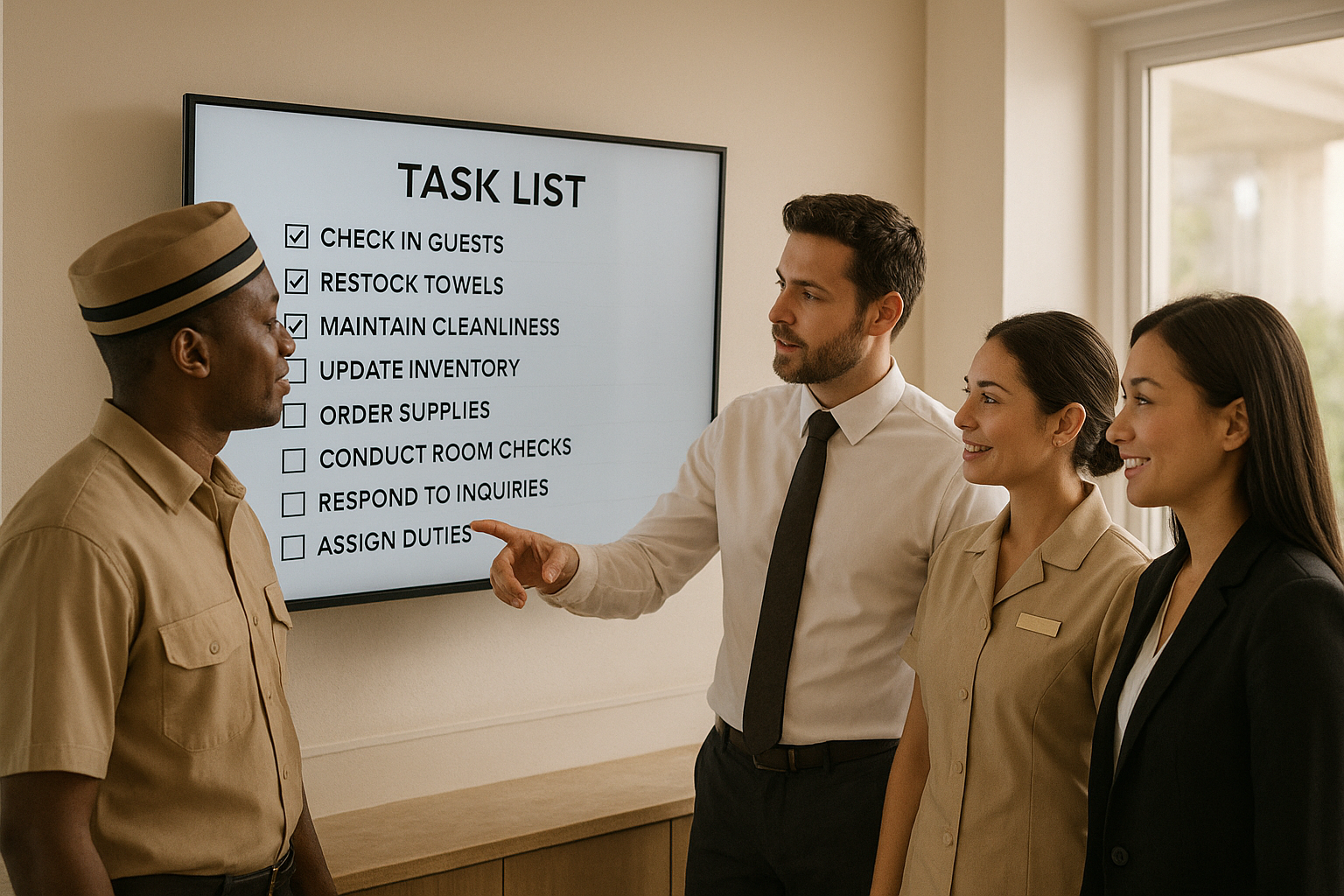
A shared view helps small teams stay aligned without extra meetings.
Final Thoughts on Choosing Hotel Staff Task Management Software
Hotel staff task management software is no longer a nice-to-have for independent hotels; it is a practical response to lean staffing and increasingly multilingual guests. The right platform captures every request, routes it to the correct department, and proves that safety-sensitive notes like allergies were actually seen.
For boutique hotels and short-term rentals specifically, the winning approach tends to skip the PMS integration entirely and focus on fast setup, unlimited seats, and translation that works both ways. Ultimately, whether a property chooses Cortesia or a competing platform, the goal stays the same: fewer missed requests, faster responses, and a small team delivering service that feels far larger than its headcount. Visit Cortesia to see how a no-integration setup can go live in days rather than months.