A guest communication platform is the system boutique hotels and short-term rentals use to answer guest questions, handle requests and share local knowledge without a front desk phone that never stops ringing. For independent properties with lean teams, this one tool often decides whether a stay feels effortless or frustrating. In this guide, we explain what a guest communication platform does, why staffing and language pressure are pushing owner-operators toward one, and how to choose the right system for a 10 to 150 room property.
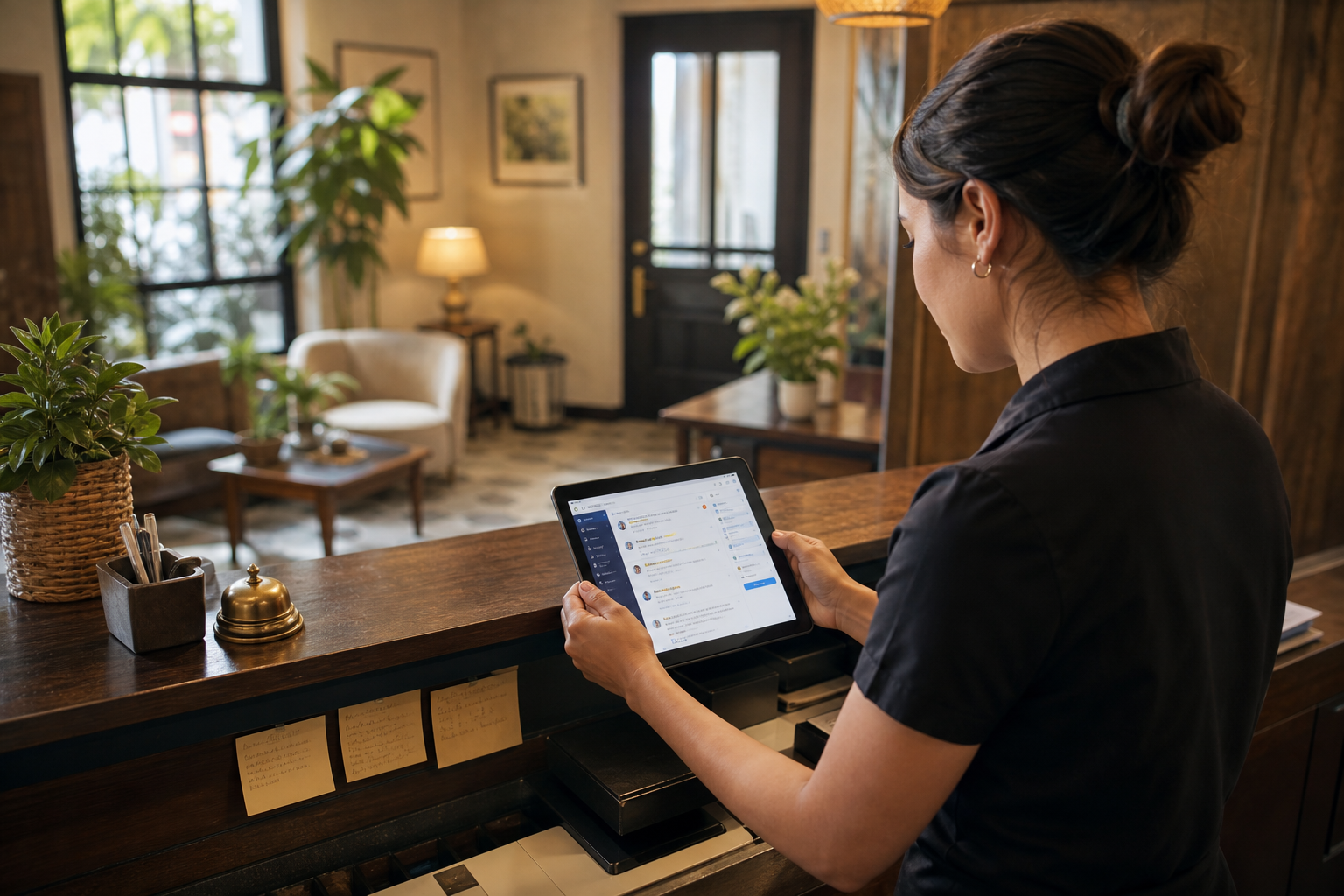
A guest communication platform gives small front-desk teams one place to see every guest request.
What Is a Guest Communication Platform?
A guest communication platform is software that lets guests send questions, requests and feedback through one channel. That channel is usually a QR code or a link. Each message goes to the right staff member, and it is often translated between the guest's language and the team's working language. In short, it replaces phone calls, paper comment cards and scattered group texts with one trackable record of every guest interaction.
In practice, a guest in Room 214 asks about breakfast hours in the guest's own language. The front desk reads that question in its working language, already logged against the right room. A platform like Cortesia pairs this messaging layer with a knowledge base built from the property's own menus, amenities and local recommendations. As a result, answers stay accurate, and staff stop typing the same reply twenty times a day.
Scanning a QR code takes seconds, while downloading an app takes effort most guests will not spend on a short stay. That is why a QR-based guest communication platform gets used, and an app often does not. The idea is simple: no app, no login.
Who Uses a Guest Messaging Platform?
The platform touches several roles, so it helps to see each one clearly.
- General managers and owner-operators see what guests ask most and where service slips.
- Front desk staff field fewer repeat questions and keep one clear queue.
- Housekeeping and maintenance receive requests for their own department, not a relayed phone message.
- Short-term rental hosts answer guests without being on site.
Why Independent Hotels Are Adopting Guest Messaging Software
Independent hotels are not adopting guest messaging software because it is trendy. Specifically, three forces are at work: thin staffing, language diversity and low app adoption. Together, they push owner-operators toward a single system for every guest request.
The Staffing Squeeze Driving Demand
According to a joint AHLA and Hireology survey, 65% of hotels report staffing shortages. Housekeeping (38%) and the front desk (26%) were named as the most critical gaps. Consequently, the staff who remain are stretched across check-ins, phone calls and in-person questions at once.
A guest communication platform cannot hire more housekeepers. It can, however, cut the interruptions each person handles by answering Wi-Fi, checkout and amenity questions automatically. In addition, every request lands in one dashboard instead of radios, sticky notes and group texts. That matters most when only two or three people are on shift.
Guests Want Answers in Their Own Language
Language is the second pressure point. Research from CSA Research found that 76% of consumers prefer to interact in their own language. Meanwhile, UNWTO figures show roughly 1.5 billion international arrivals in 2025. For a boutique hotel near a border, a university or a convention center, many guests arrive with limited English.
Without translation built into daily work, a guest with a broken air conditioner struggles to explain the problem. Some give up and write about it in a review instead. A platform that answers in the guest's own language closes that gap before it becomes public.
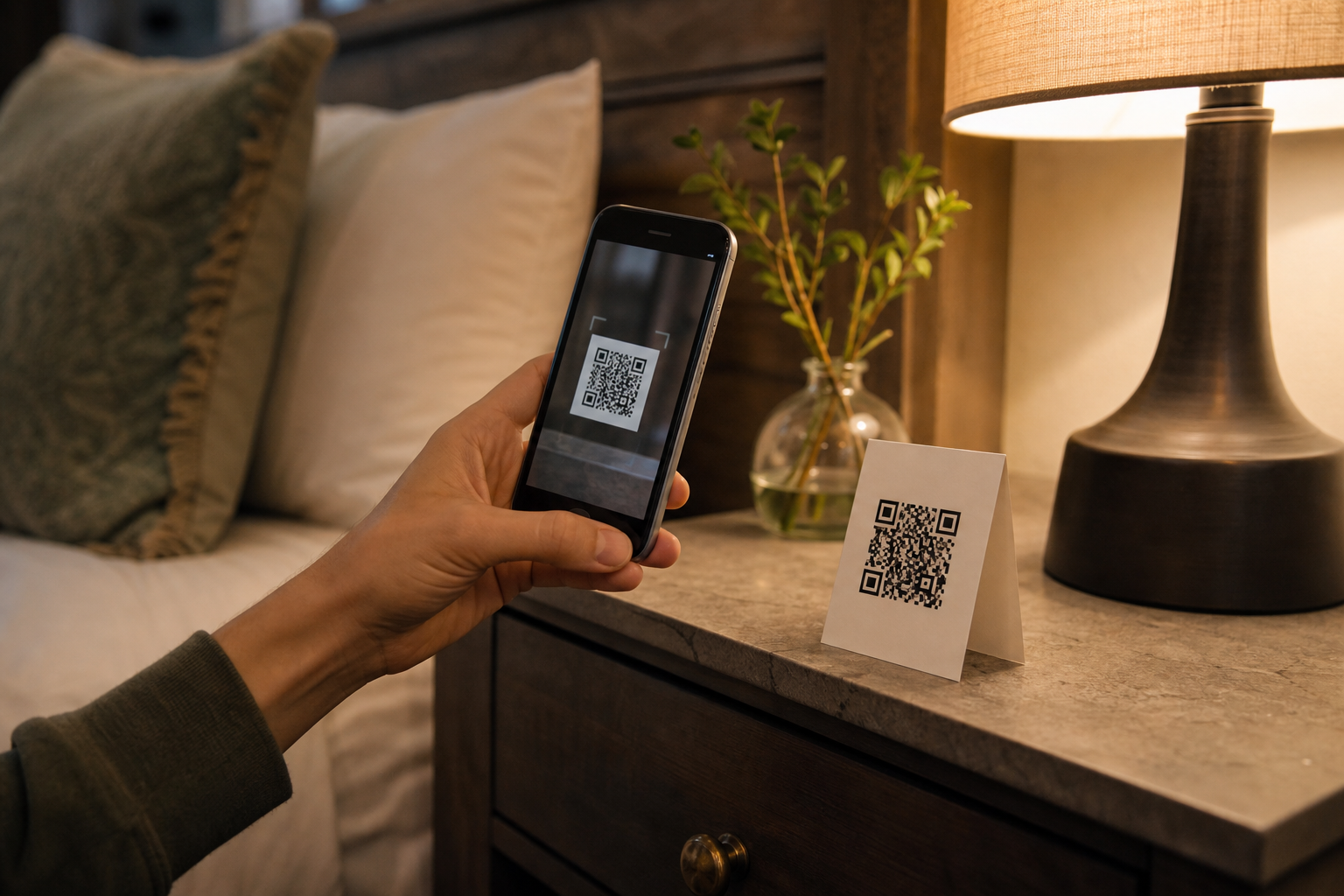
Scanning a room QR code is often the only setup step a guest ever sees.
How a Hotel Guest Communication Tool Works Day to Day
Most platforms follow the same basic sequence, whether the stay is in a 42-room boutique hotel or a single rental unit. Here is what that looks like:
- Guest scans a QR code. The guest finds a printed code in the room or welcome folder and scans it with their own phone camera. No app download, account or login is needed at any point.
- The platform recognizes the property. A branded concierge chat opens in the guest's preferred language. It draws on a knowledge base built for that property's menus, amenities and local area.
- Guest sends a question or request. The guest types something like a late checkout request or a nearby pharmacy question, in whatever language feels most comfortable.
- The request routes and translates automatically. The platform sends it to the correct department, such as housekeeping or the front desk. It is translated into the staff's working language in real time.
- Staff respond, and the guest reads it in their language. A staff member replies from the live dashboard. The guest receives the answer in the guest's own language.
Because every step happens in a browser, setup is measured in days, not months. A long property management system project is not a prerequisite for launch. In other words, a property can be live in days.
What a Guest Messaging Platform Does Across the Stay
Good guest communication is not one moment. It runs from the first message to the last goodbye, and the platform supports each stage.
Before and At Arrival
Guests ask the same early questions: parking, check-in time, Wi-Fi. Some properties share the link ahead of arrival, while others rely on the printed code in the room. Either way, the answers are ready before anyone reaches the desk.
During the Stay
This is where the platform earns its keep. Guests ask about menus, amenities and the neighborhood. They also request extra towels or report a problem. Housekeeping no longer knocks on doors guests would rather keep closed, because guests can say what they need and when.
After the Stay and Feedback
A guest who can flag a problem in the room gives staff a chance to fix it first. As a result, concerns reach the team privately and early, rather than appearing for the first time in a public review. For more on this mindset, read our take on customer care strategies for boutique hotels.
Core Features Every Guest Communication Platform Should Have
Features vary widely, so use this list as a baseline when you compare guest messaging software.
- Access without an app: a QR code or link that opens in the guest's browser.
- Built-in translation: guests and staff each read messages in their own language.
- Department routing: requests go to housekeeping, maintenance or the front desk automatically.
- A property knowledge base: answers drawn from your menus, amenities and local tips.
- A live staff dashboard: one queue organized by room and department.
- Safety flags: messages that mention health or safety are highlighted for staff.
Food Allergies and Safety Messages
A well-built platform flags a message that mentions an allergy. Staff then acknowledge it, which leaves a record of who saw it and when. However, the AI concierge is not the authority on food safety or allergies. Hotel staff preparing the food are the final authority, and guests should confirm allergy information directly with staff. Allergy information is used only for guest safety.
Guest Data and Privacy
Guests should never have to create an account to ask for a towel. With Cortesia, guests never create an account, and the app runs no analytics or advertising trackers. That keeps the experience simple for guests and the data conversation simple for you.
Comparing Guest Messaging Platforms, Texting and Hotel Apps
Not every option is a guest communication platform in the full sense. The table below shows the difference, which is worth knowing before you sign a multi-year contract.
| Method | App Needed | Translation | Staff Routing | Setup Time |
|---|---|---|---|---|
| Phone / radio | No | No | Manual | None |
| SMS / WhatsApp | No | No | Manual, one inbox | Minimal |
| Native hotel app | Yes | Rarely | Sometimes | Weeks to months |
| Guest communication platform | No | Built-in | Automatic | Days |
Several vendors tackle different parts of this problem. For a closer look, see this comparison of Cortesia and Akia, this breakdown of Cortesia versus Bellboy, or this review of Cortesia against Cloudbeds' guest messaging features. Each tool handles language support, pricing and setup differently. Therefore, the right fit depends on property size and language mix.
Choosing the Right Guest Communication Software for Your Property
Work through a short checklist before you choose. The wrong fit tends to show up within the first busy weekend.
- Does it need an app, or does a QR code work for every guest, including ones staying one night?
- How many languages does it support, and does that include right-to-left scripts?
- Is pricing predictable per room, or does it change unpredictably with usage?
- Can it go live without a long technical project?
- Does it flag safety-critical messages so staff must acknowledge them?
- Was it built for boutique and independent hotels, or scaled down from a chain product?
For a deeper walkthrough, the complete guide to hotel guest communication and this hotel guest messaging software buyer's guide cover evaluation criteria in more detail. You can also see how Cortesia approaches boutique hotels specifically. Cortesia, for example, uses simple per-room pricing with unlimited guest usage and staff seats. Onboarding includes the property knowledge base and print-ready QR materials, so a property can be live in days.
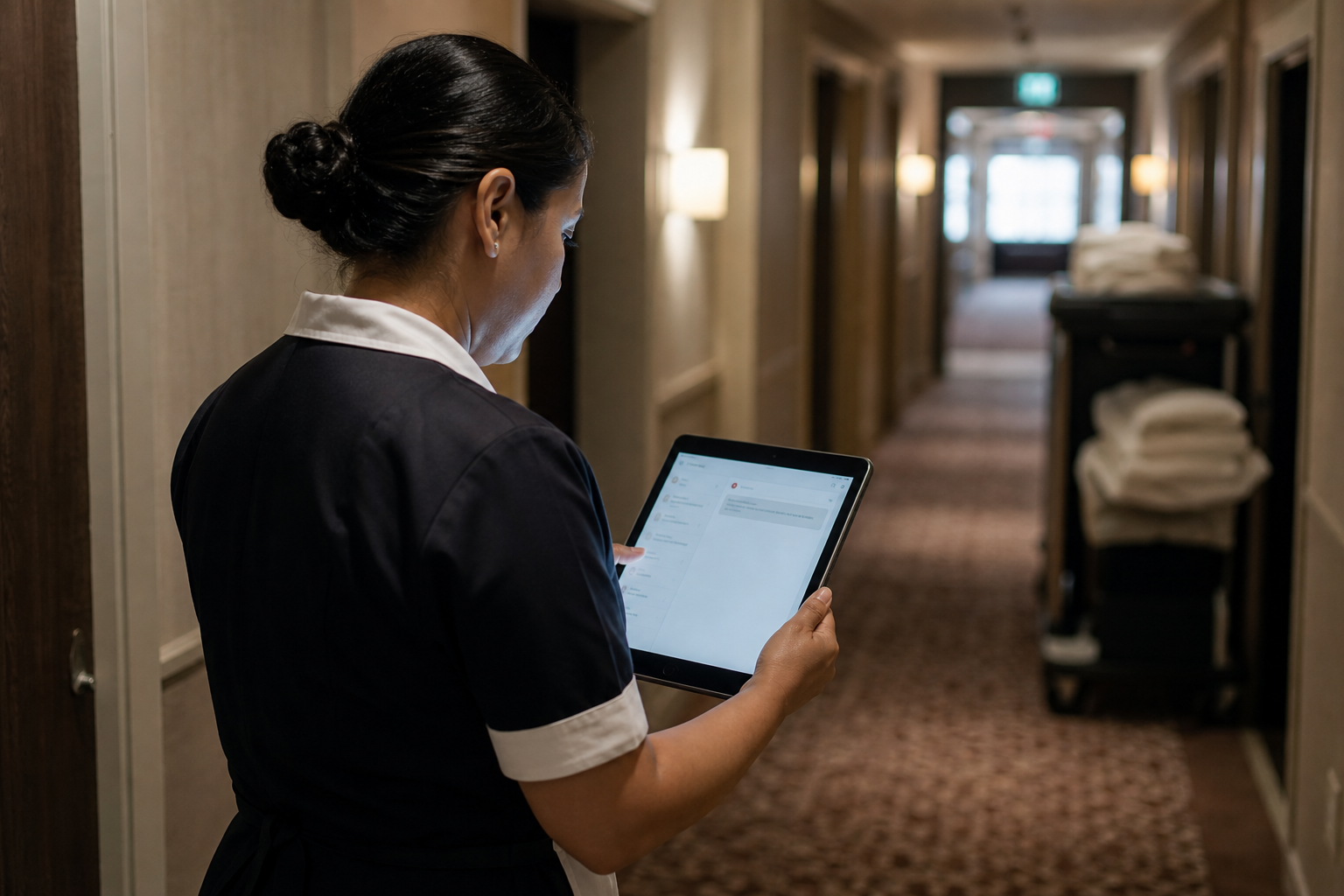
Housekeeping sees guest requests the moment they are sent, translated into their working language.
Common Mistakes and Rollout Best Practices
Mistakes to Avoid
The most common mistake is choosing a platform built for large chains. These products assume a native app and a long implementation. That mismatch leaves independent hotels paying for features they cannot realistically use.
A Simple Rollout Plan
First, load accurate property information, such as amenities, menus and local recommendations, before launch day. Next, place QR codes where guests will see them, such as the nightstand and welcome folder. Finally, train staff on how requests appear in the dashboard so nothing is missed during the first busy weekend.
Frequently Asked Questions About Guest Communication Platforms
What is a guest communication platform?
A guest communication platform is software that lets hotel guests send questions and requests through one channel, usually a QR code. Messages are routed to staff and often translated automatically. It replaces phone calls, sticky notes and scattered text threads with one trackable system.
How does a guest communication platform work for boutique hotels?
Guests scan a QR code in their room and ask a question in their own language. The platform routes and translates the request to the right staff member on a live dashboard. Staff reply in their working language, and the guest reads the answer translated back.
What is the difference between a guest communication platform and a hotel app?
A hotel app requires a download and an account, and most guests never install one for a short stay. A guest communication platform typically works through a QR code or link in the browser, so there is nothing to install.
How much does a guest communication platform cost for a small hotel?
Pricing varies by vendor. Many modern platforms charge a simple per-room monthly fee rather than per-booking or per-message rates. Cortesia uses per-room pricing with unlimited guest usage and unlimited staff seats, so costs stay predictable.
How long does it take to set up a guest communication platform?
Lightweight platforms can go live in days rather than months. Setup usually involves adding rooms and staff, building a property knowledge base, and printing QR materials.
Does a guest communication platform require a PMS integration to launch?
Not always. Some platforms are built to launch on their own, which is often why boutique properties can go live in days instead of waiting on a lengthy technical rollout.
What languages can a guest communication platform support?
It depends on the vendor. Cortesia supports eight languages end to end, including right-to-left display, so guests and staff each read every message in their own language.
Can short-term rental hosts use a guest communication platform?
Yes. A host with one rental unit can use the same QR-code approach as a multi-room hotel. No front desk or on-site staff is required for the system to work.
How does a guest communication platform handle food allergies and safety alerts?
Well-built platforms flag safety-critical messages and ask staff to acknowledge them. Hotel staff preparing food remain the final authority, and guests should confirm allergy information directly with staff. Allergy information is used only for guest safety.
How does a guest communication platform compare to texting or WhatsApp?
Texting and WhatsApp keep every conversation in one inbox, with no automatic translation or department routing. A guest communication platform organizes requests by room and department and translates messages between guest and staff.
Is a guest communication platform only for large hotel chains?
No. Enterprise guest platforms are often built and priced for large chains. Newer platforms are designed for 10 to 150 room boutique hotels and single short-term rental units.
Final Thoughts
A guest communication platform is the most practical answer to thin staffing and a multilingual guest base. The key takeaways are clear: choose no app, no login access, built-in translation, department routing and safety flags. In addition, confirm the system can go live in days and that staff remain the final word on allergies. Whether you run a 42-room boutique hotel or a single rental unit, the right guest communication platform lets a small team sound, and feel, like a much larger one.