
Hotel Guest Communication: A Complete 2026 Guide for Hotels
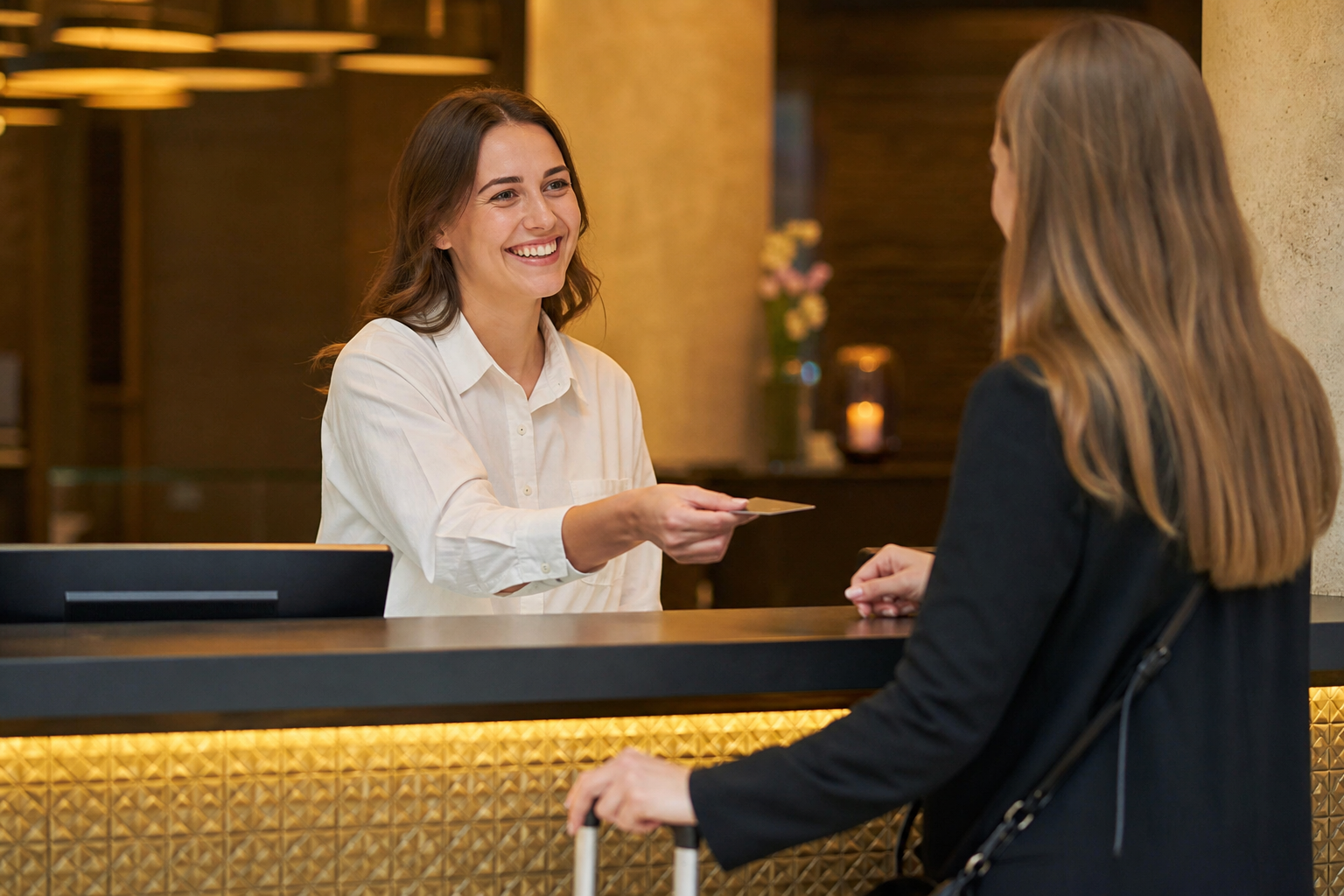
Hotel guest communication is every exchange of information that happens between your team and the people staying in your rooms, from a Wi-Fi password request at check-in to a late-night question about tomorrow's breakfast hours. For independent and boutique properties, however, this exchange usually runs through a front desk staffed by only one or two people, which means a single long phone call can bring every other task to a halt. Add a handful of guests who speak Portuguese, Mandarin, or Hebrew, and that same front desk now has to translate on the fly, often guessing more than understanding. Fortunately, fixing hotel guest communication does not require a massive technology overhaul; it requires a smarter structure for handling the questions that arrive every single day.
Quick answer: Hotel guest communication improves fastest when routine questions are handled by a self-serve, multilingual tool and only genuine service requests reach a human. That single change cuts front-desk interruptions, removes most language-related misunderstandings, and gives staff the time to actually fix what guests ask for.
What Is Hotel Guest Communication?
Hotel guest communication is every message that passes between a guest and hotel staff during a stay, including requests, questions, complaints, and service updates. It usually flows through the front desk, phone calls, text messages, or face-to-face conversation. When this communication is slow, unclear, or trapped in a single language, guest satisfaction drops fast, and staff waste hours repeating the same answers to the same five questions.
In a boutique or independent property, there is no large call center to absorb the volume. Consequently, the quality of guest communication depends almost entirely on how well a small team can triage requests, respond quickly, and understand what a guest actually needs, even when that guest does not speak the staff's language. In contrast, large chains can lean on multilingual call centers and dedicated IT departments, which is exactly why generic enterprise advice rarely fits a 20- to 60-room property.
Clear hotel guest communication starts at the front desk, but it cannot stop there.
Why Guest-Staff Communication Breaks Down in Lean Hotel Teams
Staffing is the core pressure point behind most communication failures. According to a survey by the American Hotel & Lodging Association and Hireology, 65% of hotels report staffing shortages, with housekeeping at 38% and the front desk at 26% being the most critical gaps. In other words, the people meant to answer guest questions are stretched thin before the first guest even checks in. As a result, predictable breakdowns appear across nearly every property type, regardless of star rating or location.
Breakdown | Effect on the Guest |
|---|---|
Front desk answers repeat questions | Longer lines, slower check-in |
Housekeeping knocks at the wrong time | Interrupted guests, wasted staff visits |
Allergy mentioned only once, verbally | Information lost between shifts |
Language barrier during a complaint | Guest gives up or writes a negative review |
Requests scattered across sticky notes and radios | No record exists if something goes wrong |
The Language Barrier Problem in Multilingual Guest Messaging
International travel has returned to record levels, with roughly 1.5 billion international arrivals recorded in 2025. Meanwhile, research from CSA Research shows that 76% of consumers prefer to engage in their own language whenever possible. Therefore, a hotel that only communicates in English is asking a large share of its guests to do extra work just to get a simple answer. This is not a niche problem: according to Wikipedia's overview of multilingualism, more than half the world's population regularly uses more than one language, which means monolingual guest communication is already the exception, not the rule.
Hotels have tried to solve this with downloadable apps, but adoption has stayed low. Asking a guest to download software for a two-night stay is, in practice, asking them to do work they would rather skip. In contrast, a tool that opens instantly in a browser, with no account and no install, matches how a short stay actually works. This is also why QR code concierge systems have become a practical middle ground between doing nothing and building a native app.
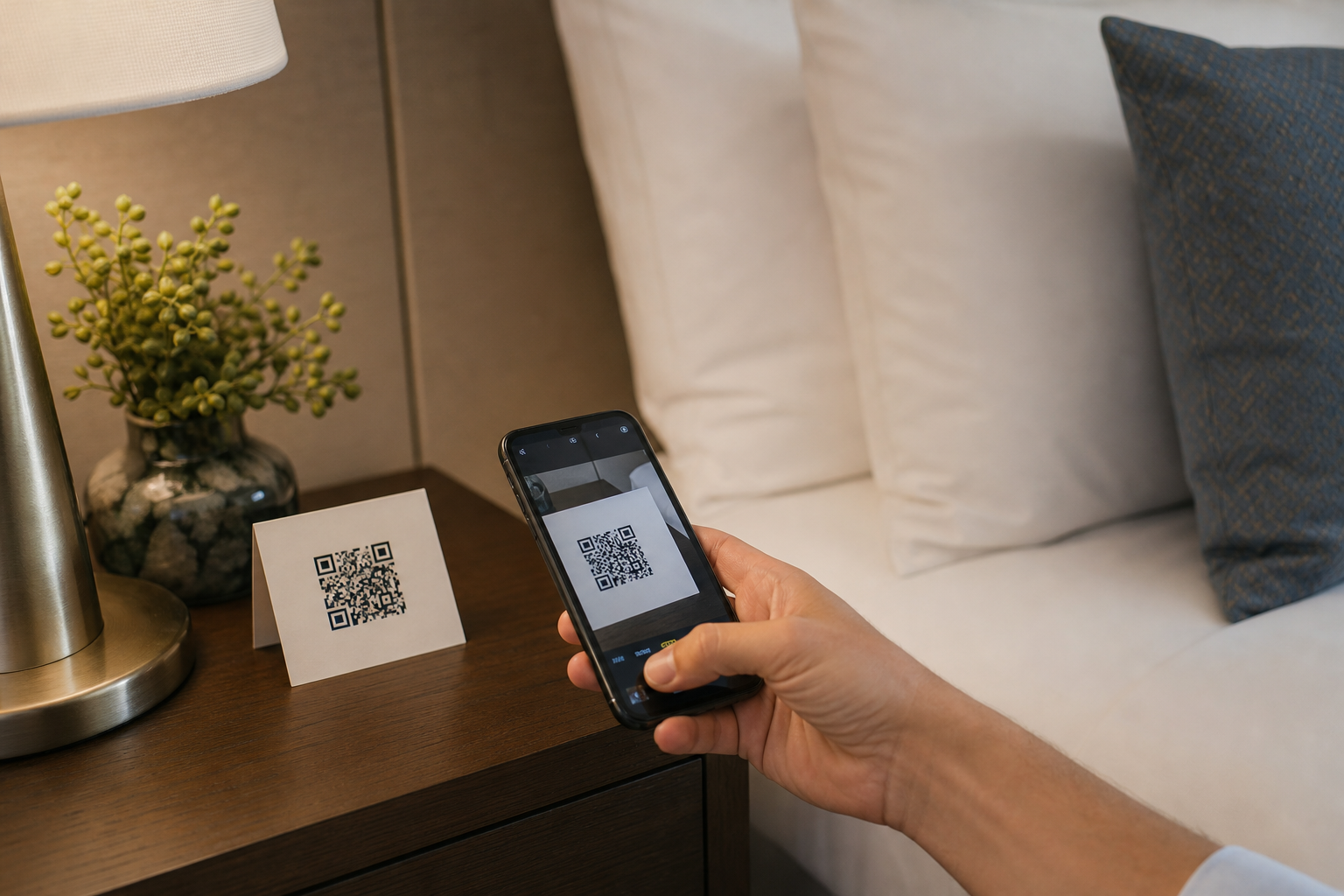
A printed QR code lets a guest start a conversation in their own language without downloading anything.
The Most Common Hotel Guest Communication Mistakes (And How to Fix Them)
Most hotel guest communication problems repeat themselves across properties of every size. Below are the eight mistakes that show up most often, along with the specific fix for each one.
Mistake 1: Relying on a Single Communication Channel
Phone-only or front-desk-only communication forces every guest into one bottleneck. The fix is simple: give guests a second, self-serve option, such as a QR code concierge, so routine questions never need to wait in a queue.
Mistake 2: Making Guests Repeat Themselves
When a request is passed verbally from the front desk to housekeeping to maintenance, details get lost, and guests end up re-explaining the same issue three times. A shared digital log eliminates this by keeping every request visible to every department at once.
Mistake 3: Assuming Every Guest Speaks English
Staff who default to slow, simplified English with non-native speakers often create more confusion, not less. Real-time translation tools remove the guesswork entirely, letting guests type in their own language while staff read the translated version instantly.
Mistake 4: Losing Requests Between Shifts
A request logged on a sticky note at 11 p.m. rarely survives a shift change. In contrast, a centralized dashboard keeps every open request visible to the morning team, so nothing quietly disappears overnight.
Mistake 5: Treating Slow Replies as Harmless
A 20-minute delay on a simple towel request feels minor to staff but major to a guest standing in a wet bathroom. Above all, fast acknowledgment, even before the task is finished, reassures guests that their message was received.
Mistake 6: Leaving Allergy and Safety Notes Unrecorded
A verbal allergy mention at check-in is easy to forget by dinner service. According to the U.S. Food and Drug Administration, food allergies can trigger severe reactions within minutes, so every mention needs a written, acknowledged record, not a memory.
Mistake 7: Never Measuring Response Time
Teams that do not track how fast they respond cannot improve it. Similarly, a property that never reviews its own data will repeat the same mistakes every season without realizing it.
Mistake 8: Over-Automating Until It Feels Robotic
Automation should remove friction, not warmth. Therefore, the best hotel guest communication systems automate routine answers while routing anything emotional, urgent, or unusual straight to a person.
How to Improve Hotel Guest Communication in 5 Steps
Fixing hotel guest communication does not require ripping out existing systems. Instead, it usually comes down to a short, sequential process that most lean teams can complete within a month.
Audit every guest request for one week. Track each question or request that reaches your front desk, phone line, or text messages for seven days, noting the guest's language and the time it took to respond.
Identify repeat questions and language gaps. Group the logged requests into categories such as Wi-Fi, checkout, dining, and maintenance, then flag which ones came from guests who were not fluent in English.
Put a QR code concierge in every room. Place a printed QR code on the nightstand, door, or welcome folder so guests can scan it with their own phone and ask questions in their native language instantly.
Route every request to the right department automatically. Connect guest messages to a shared staff dashboard that translates requests into the language your team works in, so housekeeping, front desk, and maintenance see exactly what is needed.
Track response times and close the loop. Review how quickly staff acknowledge and resolve each guest request every week, then adjust staffing or workflows so no message sits unanswered during a shift.
For properties that want a more detailed breakdown of step three, this guide on how to organize guest requests fast walks through routing logic in more depth.
QR Code Concierge Tools for In-Stay Guest Communication
A QR code concierge turns a guest's own phone into a private, branded channel for in-stay guest communication. Cortesia, for example, is built specifically for boutique and independent hotels and short-term rentals, rather than large chains with dedicated IT teams. Guests scan a code in the room and get answers, service, and local knowledge in their own language, with no app, no login, and no front-desk queue.
On the staff side, every request lands in one live dashboard, translated into the language the team works in. That means a 42-room boutique hotel with guests in eight languages, similar to Cortesia's demo property The Mesquite, can respond in real time without adding headcount. Food-allergy mentions also trigger an alert that requires staff acknowledgment, which closes a common and risky communication gap. You can see this workflow in action through the Cortesia live demo.
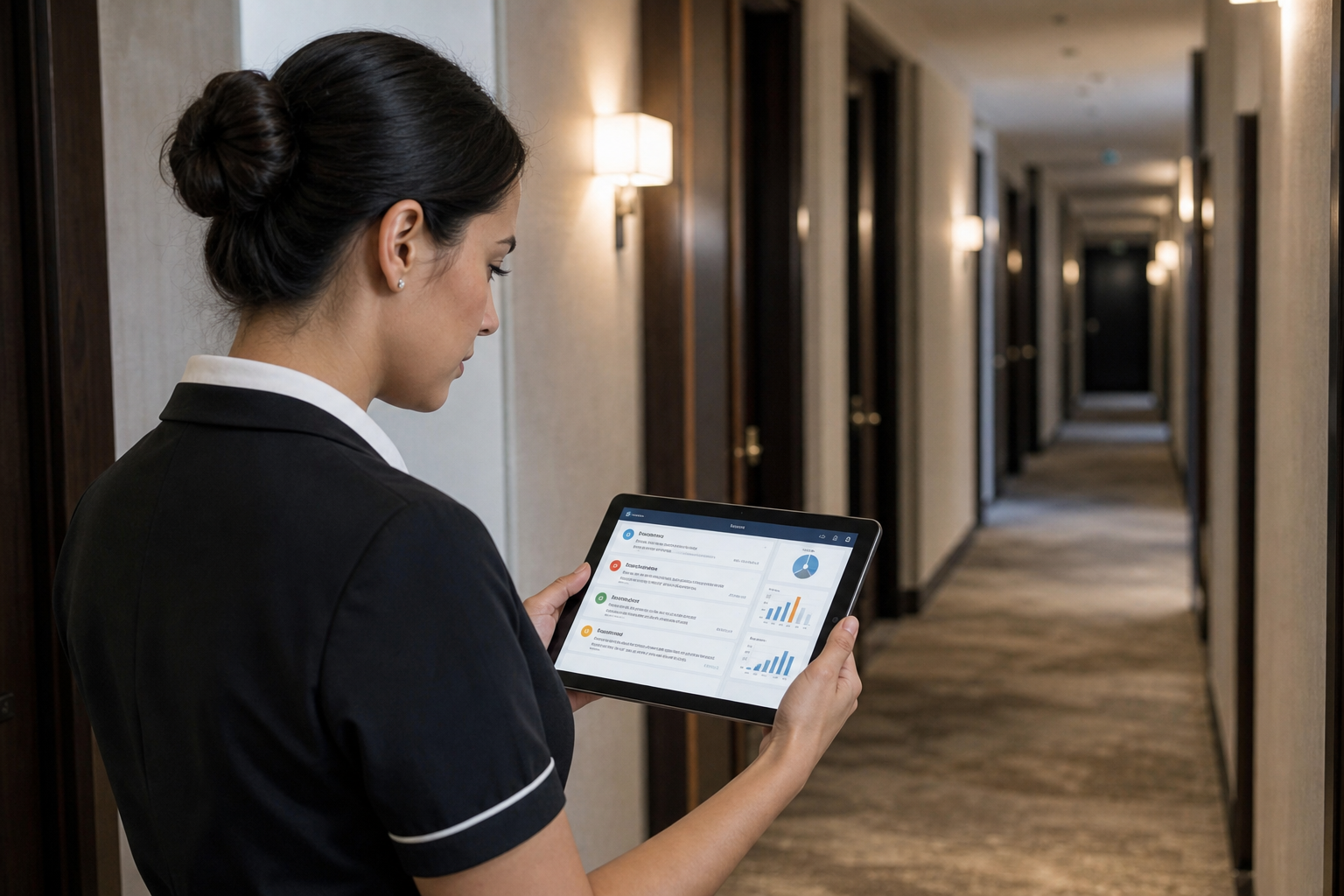
Routing translated requests to one dashboard improves hotel guest communication across every shift.
Covering the Full Guest Journey: Pre-Arrival, In-Stay, and Post-Stay Communication
Hotel guest communication does not begin at check-in and it does not end at checkout. Above all, properties that treat it as a single continuous journey see fewer surprises and more repeat bookings.
Pre-Arrival Communication
Before arrival, guests want confirmation details, parking instructions, and answers to any special requests they made at booking. Sending this proactively, in the guest's preferred language, prevents a wave of calls on arrival day.
In-Stay Communication
This is where most daily volume lives: Wi-Fi, housekeeping, dining recommendations, and maintenance issues. A QR code concierge absorbs the bulk of this traffic so staff can focus on requests that truly need a human touch.
Post-Stay Communication
After checkout, a short thank-you message and a well-timed review request close the loop. Consequently, guests who had their questions answered quickly during the stay are far more likely to leave a positive review afterward.
Choosing Guest Communication Software for Boutique Hotels
Enterprise guest platforms are typically built for chains, assuming a full property management system integration, a native app, or in-room hardware, with pricing sized for a 300-room property. Independent hotels and short-term rentals need something lighter. In particular, look for simple per-room pricing, month-to-month terms, no required PMS integration, and setup that can be completed in days rather than months.
This buyer's guide to hotel guest messaging software compares the main options in more detail, while this piece on handling room upgrade requests quickly shows how faster communication can also support revenue, not just service scores. Similarly, these welcome note templates pair well with a QR code concierge as a guest's first touchpoint.
If you are comparing specific vendors, these side-by-side breakdowns are worth reading before you commit: Cortesia vs. Duve looks at multilingual depth and setup speed, while Cortesia vs. Akia compares pricing structure and PMS requirements for independent properties.
Hotel Guest Communication KPIs: What to Measure and Why
You cannot improve what you do not measure. Therefore, every property should track a handful of simple metrics to know whether their hotel guest communication is actually getting better.
KPI | What It Measures | Target Benchmark |
|---|---|---|
First response time | How fast a request is acknowledged | Under 2 minutes |
Resolution time | How long until the request is actually solved | Under 20 minutes |
Language coverage rate | Share of guest languages your system can handle | 95%+ of guest nationalities |
Repeat-question rate | How often the same question is asked at the desk | Declining month over month |
Allergy acknowledgment rate | Share of allergy mentions confirmed in writing | 100% |
In particular, the repeat-question rate is the most revealing metric. If the same five questions keep hitting the front desk every week, that is a clear signal your guest communication system has a gap, not your staff.
Frequently Asked Questions About Hotel Guest Communication
What is hotel guest communication?
Hotel guest communication is every exchange of information between guests and staff during a stay, including requests, questions, and complaints. It typically happens through the front desk, phone, text, or a digital concierge, and its quality directly affects guest satisfaction.
Why is multilingual guest communication important for boutique hotels?
Boutique hotels often attract international travelers who do not speak the staff's primary language. CSA Research shows most consumers prefer engaging in their own language, so multilingual communication reduces misunderstandings and improves reviews.
How can hotels improve guest communication without hiring more staff?
Hotels can route routine questions, like Wi-Fi passwords or checkout times, through a self-serve digital concierge so staff only handle requests that truly need a human. This frees front-desk time without adding headcount.
What is a QR code hotel concierge?
A QR code hotel concierge is a printed code placed in a guest room that opens a mobile-friendly chat or information page when scanned. Guests ask questions or request service without downloading an app.
Does guest communication software require a PMS integration?
Not always. Some guest communication tools, including Cortesia, work without a property management system integration, which lets a hotel go live in days instead of months.
How quickly can a hotel set up a digital concierge?
A lightweight, no-integration setup can be ready in days because it only needs a property knowledge base, room list, and printed QR codes, rather than a full technical rollout.
What languages does Cortesia support?
Cortesia supports eight languages end to end, including full right-to-left Arabic, so guests can ask questions and staff can read translated replies in the language they work in.
How much does hotel guest communication software cost?
Pricing varies by vendor, but simple per-room, month-to-month pricing with unlimited guest and staff usage is common among tools built specifically for independent hotels, unlike enterprise platforms priced for large chains.
Can short-term rental hosts use guest communication tools too?
Yes. A single-unit rental host without a front desk can use the same QR-code approach to answer guest questions remotely and in the guest's own language, as shown in Cortesia's Henderson House demo for a Dallas rental.
What happens when a guest mentions a food allergy?
A well-designed guest communication system should flag allergy mentions and require staff acknowledgment, creating a record that the information was received and acted on.
What's the difference between a hotel app and a QR code concierge?
A hotel app requires a download, account, and storage space on the guest's phone, and most guests never install one. A QR code concierge opens instantly in a browser with no download.
How does guest communication affect online reviews?
Slow or unclear responses to simple requests are a common complaint in negative reviews. Faster, clearer hotel guest communication tends to show up as praise for staff responsiveness instead.
What are common mistakes hotels make with guest communication?
Common mistakes include relying only on English-speaking staff, scattering requests across phone, text, and sticky notes, and having housekeeping guess at room status instead of asking guests directly.
How does staff dashboard translation work?
A guest types a message in their own language, the platform translates it for staff in real time, and the staff reply is translated back, so neither side needs to speak the other's language.
What is the single biggest hotel guest communication mistake?
The biggest mistake is forcing every guest question through one channel staffed by one person. This single bottleneck is behind most of the slow replies, language mix-ups, and lost requests that frustrate guests.
Should hotels communicate through multiple channels or consolidate into one?
Hotels should offer guests more than one way to reach out, such as a QR code concierge alongside the front desk, but every channel should feed into one staff dashboard so nothing gets duplicated or missed.
What KPIs should hotels track to measure guest communication?
The most useful metrics are first response time, resolution time, language coverage rate, repeat-question rate, and allergy acknowledgment rate, since each one points to a specific, fixable process gap.
Final Thoughts: Turning Hotel Guest Communication Into a Competitive Advantage
In the end, hotel guest communication is not solved by hiring more people; it is solved by removing friction from the questions that do not need a human and making sure the ones that do reach the right person fast, in whatever language the guest speaks. A short audit, a QR code concierge, and a translated staff dashboard can take a lean boutique team from reactive to responsive within weeks. For properties ready to test this directly, tools like Cortesia offer a practical starting point without a long implementation project, and a quick visit to cortesia.ai is enough to see the live demo for yourself.