
QR Code Hotel Concierge: A Guide for Boutique Hotels
A QR code hotel concierge turns a small printed code into an instant, multilingual concierge that lives on every guest's own phone. Instead of ringing the front desk or flipping through a laminated directory, guests simply scan the code and receive answers, service requests, and local recommendations in their own language, with nothing to download and no account to create. For boutique hotels and independent short-term rentals running lean teams, this inexpensive printed card is quietly replacing an entire layer of front-office friction.
Consequently, properties that once relied on a single multilingual staffer to catch every guest question are now spreading that same coverage across eight languages, around the clock, without adding headcount. This guide goes further than most introductions to the topic: it covers how a QR code hotel concierge works step by step, what it costs, how secure it is, how it compares to apps and legacy front-desk software, and the mistakes that quietly sabotage a rollout. By the end, there should be no open question left about whether a QR code hotel concierge belongs in your property.
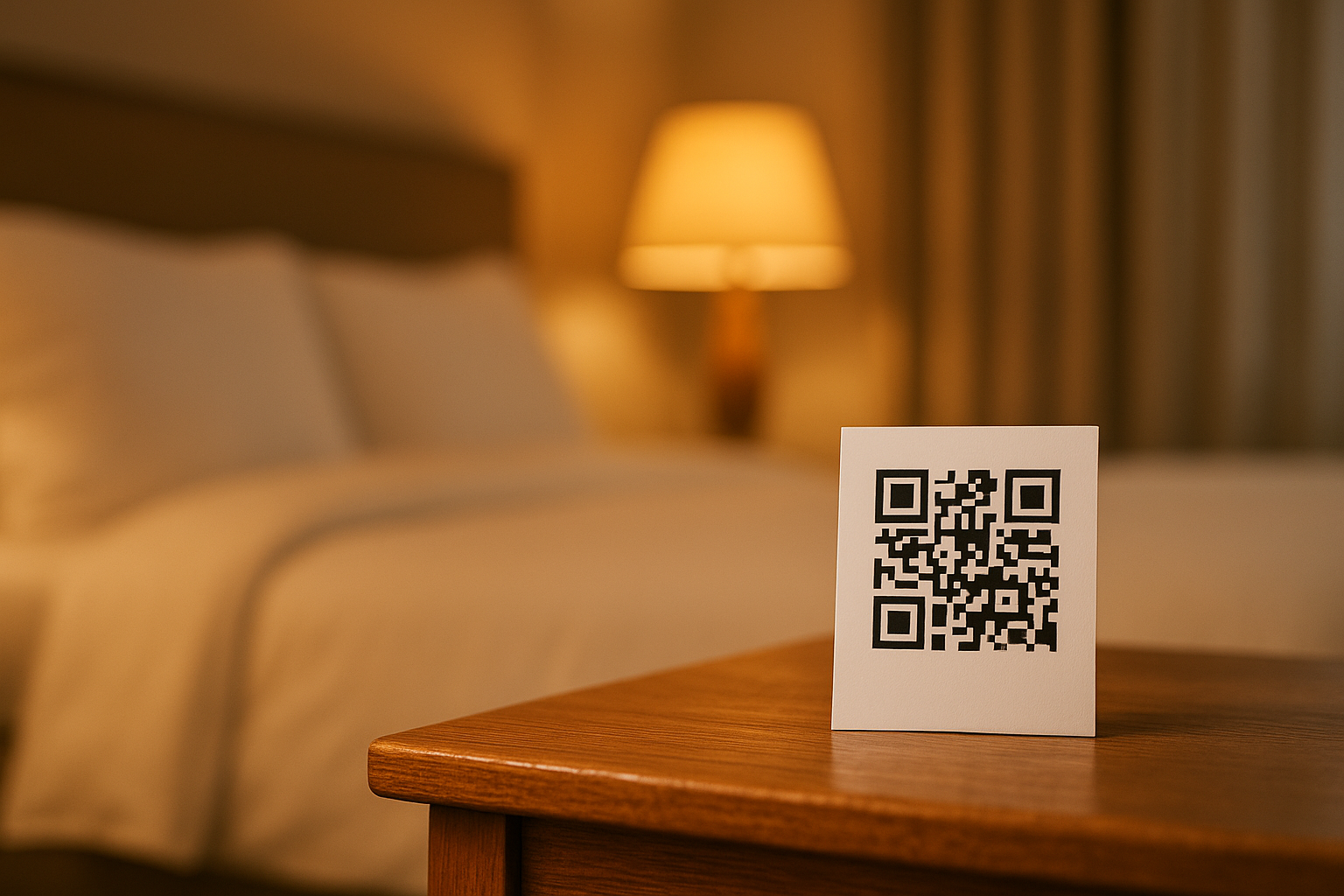
A QR code hotel concierge card gives every guest instant access to service in their own language.
What Is a QR Code Hotel Concierge, Exactly?
A QR code hotel concierge is a chat-based service that opens directly in a guest's phone browser after they scan a code, with no app, login, or guest account required. It answers common questions, such as Wi-Fi passwords, breakfast hours, and checkout times, while also routing service requests, like extra towels or a maintenance issue, to the right department.
Unlike a printed directory, it can hold a real conversation, understand a question phrased differently, and reply in whichever of the property's supported languages the guest is using. In particular, this matters because a code by the door is more likely to be used than an app that has to be found, downloaded, and set up before it does anything useful. In short, a QR code concierge removes every piece of friction standing between a guest's question and a useful answer.
Readers weighing a broader digital concierge strategy may also find it useful to review what boutique hotels need from a digital concierge, since a QR code is simply the entry point into that larger system.
How a QR Code Hotel Concierge Works, Step by Step
In practice, the process is short enough that most properties can go live within days. Here is the typical flow, from the guest's first scan to a resolved request on the staff side.
Print and place the QR code. The property prints its unique code onto a room card, key sleeve, or welcome folder, positioned where a guest naturally looks on arrival.
The guest scans and starts a chat. A camera scan opens a branded chat instantly, in the guest's own language, with no download and no login screen standing in the way.
The request routes to the staff dashboard. Every message lands on one live dashboard, automatically translated into the language the team actually works in.
Staff respond and close the loop. A staff member replies from the dashboard, the guest reads the answer in their own language, and the request is marked resolved.
Notably, this is the same basic flow Cortesia uses across its demo properties, including a 42-room boutique hotel and a single-unit short-term rental, which shows the model scales down as easily as it scales up. Anyone can see the flow in action through the live Cortesia demo.

Every guest message is translated automatically before it reaches the staff dashboard.
QR Code Hotel Concierge vs. Hotel App vs. Phone Calls
Before choosing a system, it helps to see the three main options side by side. In contrast to a native app or a phone call to the front desk, a QR code concierge sits in a middle ground that favors speed and simplicity over heavy functionality.
Factor | QR Code Concierge | Hotel App | Front Desk Phone |
|---|---|---|---|
Setup for guest | Scan, no install | Download, account, permissions | Dial extension, wait for pickup |
Language coverage | Automatic, multiple languages | Depends on app build | Limited to staff on shift |
Typical adoption rate | High, near-universal for short stays | Low, most guests never install | High, but staff-dependent |
Implementation time | Days | Weeks to months | Already exists, but not scalable |
As the table shows, a QR code hotel concierge captures most of an app's functionality without the adoption problem, while still giving guests faster answers than a phone call during a busy shift.
Why Boutique Hotels Are Switching to QR Code Concierge Systems
Staffing is the pressure point behind this shift. According to an AHLA and Hireology survey, 65% of hotels report staffing shortages, with housekeeping and the front desk named as the most critical gaps. As a result, the same lean team that used to answer the phone all day is now also expected to personally welcome every guest.
By the numbers: 65% of hotels face staffing shortages (AHLA), 76% of consumers prefer their own language (CSA Research), and roughly 1.5 billion international trips happened in 2025 (UN Tourism). Together, these three data points explain why a QR code hotel concierge has moved from novelty to necessity.
Language adds a second layer of pressure. Research from CSA Research found that 76% of consumers prefer to engage in their own language, and international travel has returned to record levels, with roughly 1.5 billion international arrivals in 2025 according to the UN Tourism barometer. A guest who cannot explain an allergy or a broken air conditioner in English either gives up or gets misunderstood, and either outcome tends to end up in a review.
Meanwhile, hotel apps have never solved this well. Years of industry data show that only a small share of guests ever install a hotel's own app for a short stay. A QR code concierge sidesteps that problem entirely, since the "installation" is just a camera pointed at a code for two seconds. For a wider look at how lean teams manage every guest touchpoint, see this complete guide to hotel guest communication.
Key Features to Look for in a Hotel QR Code Concierge
Not every QR-based tool offers the same depth. Above all, a property should confirm the platform actually understands its rooms, menus, and neighborhood, rather than giving generic answers. It also helps to check whether:
Staff requests land in one dashboard instead of scattered texts, calls, and sticky notes.
Safety-related mentions, such as a food allergy, trigger an alert that a staff member must acknowledge.
Setup is guided, so the property doesn't have to build the knowledge base entirely on its own.
Pricing is simple and month-to-month, without a long-term contract locking the property in.
Branding is customizable, so the chat window and printed code feel like an extension of the property rather than generic software.
Reporting shows which questions come up most, so staff can fix recurring issues instead of just answering them repeatedly.
Cortesia, for instance, includes property knowledge base setup, room and staff import, and print-ready QR materials as part of onboarding, alongside a plain-language terms of service that allows cancellation at any time. That kind of transparency matters more for a 20-room property than it does for a 500-room chain with a legal department reviewing every clause.
Multilingual Guest Service and the QR Code Concierge Advantage
Language is where a QR code hotel concierge earns its keep most visibly. A guest arriving from Tokyo, Berlin, or Riyadh can ask a question in their native language and get an accurate answer, while the staff member on shift reads and replies in English, or whatever language the property runs on.
Similarly, this removes one of the most stressful moments in a guest's stay: trying to explain a medical need, a lost item, or a billing question through a language barrier at a front desk with a line forming behind them. Full right-to-left language support, such as Arabic, also matters for properties near universities, hospitals, or convention centers with a genuinely international guest mix.
For properties building a broader hospitality culture around this idea, these boutique hotel customer care strategies pair well with a multilingual concierge, since language access is only one part of a genuinely attentive guest experience.
QR Code Hotel Concierge vs Traditional Front Desk Tools
Traditional front-desk software was largely built for chains with a PMS integration budget and an IT team standing by. Independent hotels, by contrast, often need something they can set up themselves in an afternoon. A closer look at how a QR code concierge compares to legacy front-desk tools shows the gap clearly: fewer moving parts, no hardware in the room, and no long implementation timeline.
The same is true when comparing specific guest-messaging vendors. For example, a side-by-side of Cortesia against Bellboy or Cortesia against Canary Technologies highlights differences in language coverage, setup time, and whether a PMS integration is actually required to get started. Reviewing these comparisons before signing a contract helps a small property avoid paying for enterprise features it will never use.
What a QR Code Hotel Concierge Costs (and How to Budget for One)
Pricing is one area where a QR code concierge beats almost every alternative. Rather than a large upfront license fee or a percentage of booking revenue, most vendors charge a simple per-room, month-to-month rate. As a result, a 10-room inn and a 150-room boutique hotel can both budget for the tool with a single line item.
In addition, there is usually no hardware cost. A QR code prints onto existing room cards, key sleeves, or lobby signage, so the only real expense is printing and, occasionally, laminating a sign. Compare that to a PMS-integrated guest app, which often carries setup fees, developer time, and an ongoing maintenance contract.
When evaluating return on investment, it helps to think in terms of staff hours saved rather than revenue generated directly. Specifically, if a front-desk employee fields twenty repetitive questions a day and a QR code concierge absorbs half of them, that is roughly an hour of staff time freed up every single shift, time that can go toward in-person service, upselling, or simply keeping the lobby running smoothly during check-in rushes.
Is a QR Code Hotel Concierge Secure? Data Privacy Explained
Security concerns are natural whenever a guest-facing technology touches personal information. However, a well-built QR code hotel concierge is actually lower-risk than many alternatives, since it typically requires no guest account, no login, and no stored payment details. The guest scans, chats, and leaves no persistent profile behind.
That said, properties should still confirm a few basics before signing up. Specifically, ask whether guest conversations are encrypted in transit, whether the vendor allows a property to export or delete guest data on request, and whether staff access is limited to the people who actually need it. Reputable vendors answer these questions clearly and in writing, usually in their terms of service.
In particular, the CISA guidance on securing everyday technology is a useful baseline for any property evaluating a new guest-facing tool, since the same principles, limiting data collection, verifying encryption, and controlling access, apply directly to a QR code concierge.
QR Code Hotel Concierge for Short-Term Rentals and Small Portfolios
A QR code hotel concierge is not limited to buildings with a staffed lobby. In fact, it may matter even more for a single rental unit or a small portfolio managed remotely, since there is no front desk at all to catch a guest's question.
A host can place the code on the entry door, the welcome binder, or the coffee maker, and monitor requests from a phone while managing several properties at once. Consequently, a guest who cannot figure out the thermostat or the door code at 11 p.m. gets an immediate answer instead of a panicked text message to a host who is asleep.
For hosts refining the broader arrival experience, pairing a QR code concierge with thoughtful in-room materials, such as these welcome note templates and placement tips, creates a first impression that feels personal even when no one is physically present to greet the guest.
Common Mistakes When Implementing a QR Code Concierge
Even a simple tool can underperform if it's rolled out carelessly. The most frequent misstep is hiding the code somewhere a guest won't look, such as inside a drawer or on the back of a door, instead of on the entry table or key sleeve where eyes naturally land.
Another common error is skipping staff training on how requests actually reach the dashboard, which leads teams to keep using texts and radios out of habit. Finally, properties sometimes forget to update the knowledge base when menus, hours, or amenities change, which quickly erodes guest trust in the answers. A quick monthly review of the property's content, similar to reviewing a website, keeps the concierge accurate.
Overall, these mistakes share one root cause: treating the QR code concierge as a one-time install rather than an ongoing part of guest service. Properties that assign one staff member to own the knowledge base and review flagged conversations weekly tend to see far stronger results than those who set it up once and forget about it.
The Future of QR Code Concierge Technology in Hospitality
Looking ahead, QR code concierge systems are likely to absorb more of what a human concierge used to do by memory, such as recommending a nearby restaurant based on dietary restrictions or flagging a guest's preference from a previous stay. As natural language technology improves, these conversations will feel less like scripted menus and more like talking to a knowledgeable staff member who happens to be instantly fluent in every language.
Above all, the properties that adopt this technology early are building a habit with their guests: scan first, ask later. That habit compounds in value as more amenities, from spa bookings to local tour reservations, get folded into the same chat thread, reducing the number of separate tools a guest has to juggle during a stay.
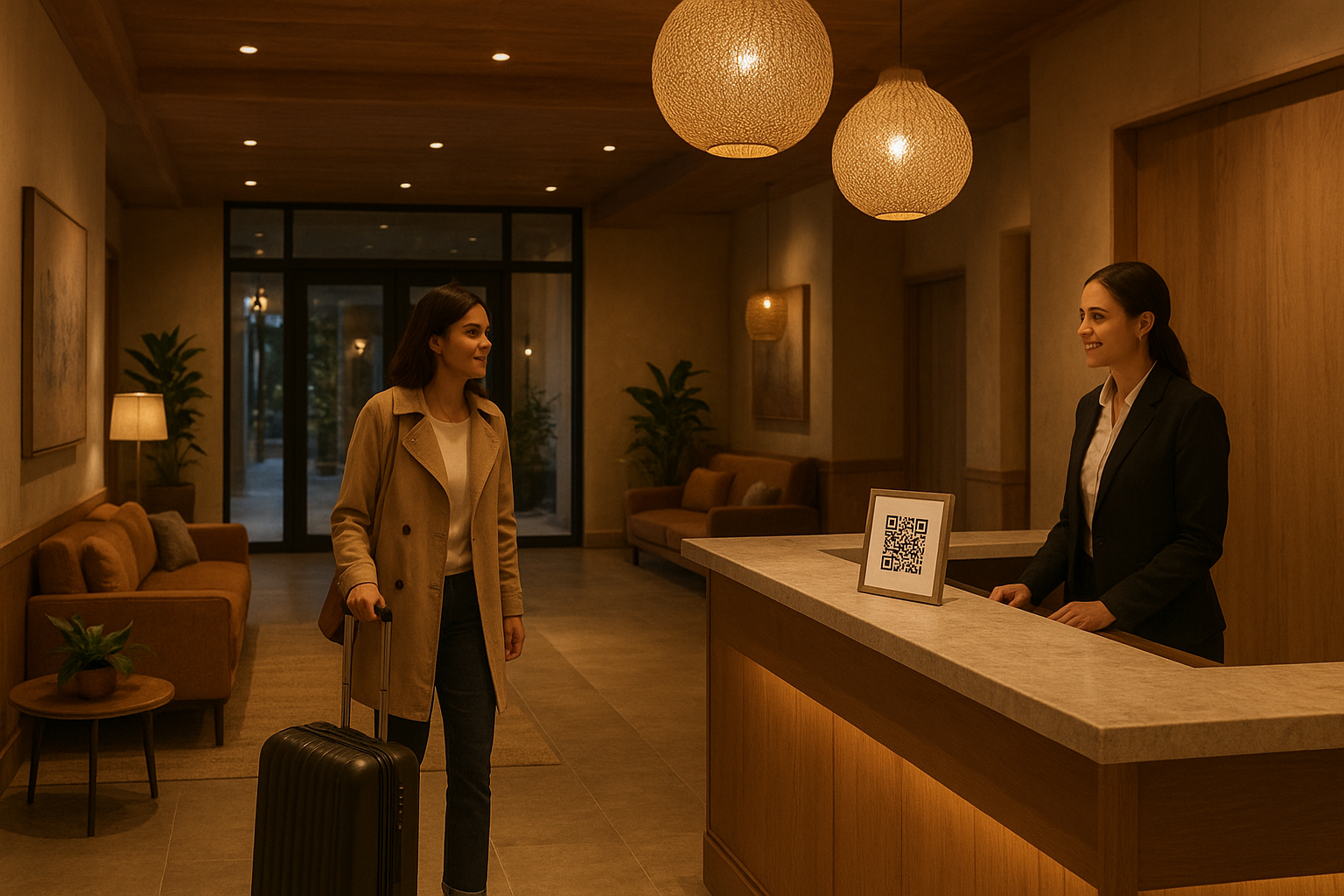
A well-placed QR code sign in the lobby helps every guest find the concierge on arrival.
Frequently Asked Questions About QR Code Hotel Concierge
What is a QR code hotel concierge?
A QR code hotel concierge is a digital service that guests reach by scanning a printed code, giving them instant answers, service requests, and local recommendations in their own language. It replaces printed directories and app downloads with a simple scan-and-chat experience.
How does a QR code hotel concierge work with a hotel's existing systems?
Most platforms, including Cortesia, run independently of the property management system and need no integration project. The property imports its room list and knowledge base, and staff go live within days rather than months.
Why are boutique hotels adopting QR code concierge systems instead of apps?
Guests rarely download an app for a short stay, but nearly everyone will scan a code already visible on their phone. As a result, a QR code concierge removes that friction while still delivering translated, on-brand answers.
How much does a QR code hotel concierge cost?
Pricing varies by vendor, though many use simple per-room, month-to-month pricing with no long-term contract. This keeps costs predictable for a 10-room inn and a 150-room boutique property alike.
How long does it take to set up a QR code hotel concierge?
Setup typically takes days rather than months, since there is no PMS integration or native app to build. The work mainly involves loading the property's knowledge base, importing rooms and staff, and printing QR materials.
What languages can a QR code hotel concierge support?
Cortesia supports eight languages end to end, including full right-to-left Arabic, so guests read and write in their own language while staff work in theirs. Every message is translated automatically in both directions.
Is a QR code hotel concierge secure for guest data?
A well-built QR code concierge does not require a guest account, login, or stored payment details, which limits exposure. Reputable vendors also let a property export or delete guest data on request.
What is the difference between a QR code hotel concierge and a hotel guest app?
A guest app requires a download, an account, and often a PMS integration before it provides any value. In contrast, a QR code concierge opens instantly in the phone's browser, with no install and no login.
Can short-term rental hosts use a QR code hotel concierge?
Yes, a QR code concierge works well for a single rental unit or a small portfolio managed remotely, since it needs no front desk at all. A host can place the code at check-in and monitor requests from any device.
What common mistakes do hotels make when rolling out a QR code concierge?
The most common mistake is placing the code somewhere guests won't naturally look, instead of the entry table or key sleeve. Another is skipping staff training on how requests route to the live dashboard, so teams keep relying on texts and radios.
Does a QR code hotel concierge replace front desk staff?
No, it is designed to remove repetitive questions from the staff's workload, not to replace the team. Staff still handle judgment calls, complex requests, and in-person service, just with far fewer routine interruptions.
How does a QR code hotel concierge handle food allergies or safety alerts?
In Cortesia, a mention of a food allergy automatically triggers a staff alert that requires acknowledgment, creating a written record. This closes a common gap where allergy information is mentioned once and then lost between the guest, the front desk, and the kitchen.
Does a QR code hotel concierge work without Wi-Fi or cell service?
A QR code hotel concierge needs an internet connection to load the chat, so most properties pair the code with reliable guest Wi-Fi covering the lobby and rooms. If a guest has no Wi-Fi and poor cell signal, the concierge will not load until a connection is available, which is why strong in-room Wi-Fi is worth checking before launch.
Can a QR code hotel concierge be customized with a hotel's branding?
Yes, most platforms let a property add its logo, color scheme, and tone of voice to the chat interface so it feels like an extension of the brand rather than generic software. Cortesia, for example, applies the property's branding to both the chat window and the printed QR materials during onboarding.
What happens if a guest loses or damages the printed QR code?
Because the QR code simply links to a web address, a damaged or missing card is easy to replace by reprinting it from the property dashboard. Staff can also keep a backup code at the front desk or write the short link manually for a guest who cannot scan.
Bringing It All Together
In summary, a QR code hotel concierge gives boutique hotels and short-term rentals a practical way to close two gaps at once: too few staff and too many languages. Instead of a front desk fielding the same ten questions all day, a printed code turns each guest's own phone into a branded, multilingual concierge that answers instantly and routes anything more complex straight to the right department.
Ultimately, the properties that benefit most are the ones that treat setup seriously: placing the code where guests will see it, training staff on the dashboard, and keeping the knowledge base current. Done well, a QR code hotel concierge lets a lean, boutique team deliver the kind of personal, five-star service that used to require a much bigger front office. Properties exploring this shift can review how it works in more detail at Cortesia or step through the live demo directly.