
Customer Care in Hotels: Boutique Hotel Strategies
Customer care in hotels is what separates a guest who books again from one who never returns, and it starts long before a guest ever reaches the front desk. In fact, the first test of customer care in hotels often happens during the booking inquiry itself, when a traveler messages a property with a question and waits to see how quickly, and how well, someone answers. For boutique and independent properties, however, the usual fixes (hiring more staff, building a native app, or subscribing to an enterprise platform built for a 300-room chain) rarely work on a lean budget. This guide covers the entire guest journey, from that first pre-booking message to the final post-stay review, and shows how multilingual, no-app technology helps small hotels deliver big-brand service at every stage.
In short: customer care in hotels means every interaction a guest has with a property, from a pre-booking question on a third-party site to a housekeeping request at 11 p.m., handled quickly, accurately, and in a language the guest actually understands. Properties that set clear response-time standards across booking channels, then pair in-stay service with a simple no-app tool such as a QR-code concierge, consistently resolve more requests on first contact and avoid the language-related misunderstandings that drive one- and two-star reviews.
What Is Customer Care in Hotels?
Customer care in hotels is the practice of anticipating, communicating, and resolving everything a guest needs, rather than simply reacting to complaints after the fact. Specifically, it covers everyday requests: fresh towels, restaurant recommendations, a late checkout, along with quieter moments where a guest's comfort or safety is on the line, such as a food allergy or a broken air conditioner. The concierge tradition at the heart of hospitality has always rewarded personal attention; the modern challenge is delivering that attention at scale with a smaller team and across a booking funnel that now spans a hotel's own website, OTAs (online travel agencies, the third-party booking sites like Expedia or Booking.com), social media, and phone.
Unlike customer service in retail, hotel care is continuous across an entire journey, not a single transaction. A guest who messages about accessibility needs before booking expects the front desk to already know at check-in, and a guest who mentions an allergy at check-in expects the kitchen to know by dinner. As a result, good care depends on information moving cleanly between every stage and every department, not just on a friendly greeting at arrival.
The Four Stages of Customer Care in Hotels
Above all, it helps to think of hotel guest care as four connected stages rather than one isolated function. Each stage creates the conditions for the next, and a weak link anywhere in the chain shows up in reviews.
Pre-Booking Customer Care: The First Impression
Pre-booking customer care in hotels happens the moment a traveler sends a question through a website chat widget, an OTA message thread, or a social media direct message. Consequently, how fast and how clearly that question gets answered often decides whether the traveler books with that property or clicks through to a competitor instead. A slow or generic reply signals the kind of service a guest can expect for the rest of the stay, which makes this stage far more important than many independent hotels realize.
Pre-Arrival and Check-In Communication
Once a reservation is confirmed, pre-arrival communication sets expectations: parking instructions, check-in times, and any special requests a guest has already shared. In addition, this is the stage where a property should confirm anything safety-relevant, such as a food allergy or mobility need, so nothing is a surprise at the front desk.
In-Stay Guest Care and Service Recovery
This is the stage most people picture when they hear "customer care in hotels": housekeeping requests, maintenance issues, dining questions, and the occasional complaint that needs fast service recovery. It is also the stage where language barriers and staffing shortages do the most damage, which is why the rest of this guide focuses heavily on it.
Post-Stay Follow-Up and Review Management
Finally, post-stay care includes thank-you messages, review requests, and how a hotel responds publicly when something went wrong. Indeed, a thoughtful reply to a critical review can recover trust even when the stay itself had problems, while silence after a bad review compounds the damage.
Why Hotel Guest Service Is Under Pressure Right Now
Staffing, above all, is the pressure point behind most hotel service problems today. An AHLA and Hireology survey found that 65% of hotels report staffing shortages, with housekeeping (38%) and the front desk (26%) named as the most critical gaps, according to the American Hotel & Lodging Association. As a result, the same ten questions pile up at the front desk while the phone keeps ringing, a pre-booking message sits unanswered in an OTA inbox, and a guest waits at the counter.
Meanwhile, housekeeping staff knock on occupied rooms, get turned away, and lose time they cannot recover on a lean schedule. Consequently, small lapses (a missed Wi-Fi password, an unanswered allergy note, a booking question that never got a reply) compound into the kind of review that costs a boutique property future bookings.
The Language Barrier Problem in Hotel Guest Experience
Hotel guest experience quickly breaks down when a guest cannot explain what they need. Indeed, research from CSA Research shows that 76% of consumers prefer to engage in their own language, and a guest who cannot describe an allergy or a maintenance issue in English either gives up or gets it wrong. Furthermore, international travel has returned to record levels, with roughly 1.5 billion international arrivals recorded in 2025 according to the UN World Tourism Organization, so the share of non-English-speaking guests at independent hotels keeps growing.
As a result, a property near a university, a convention center, or a border city cannot treat multilingual service as optional anymore. Above all, the guests most likely to need extra help (someone booking through an OTA listed in their native language, for example) are often the guests least able to ask for it in English once they arrive.
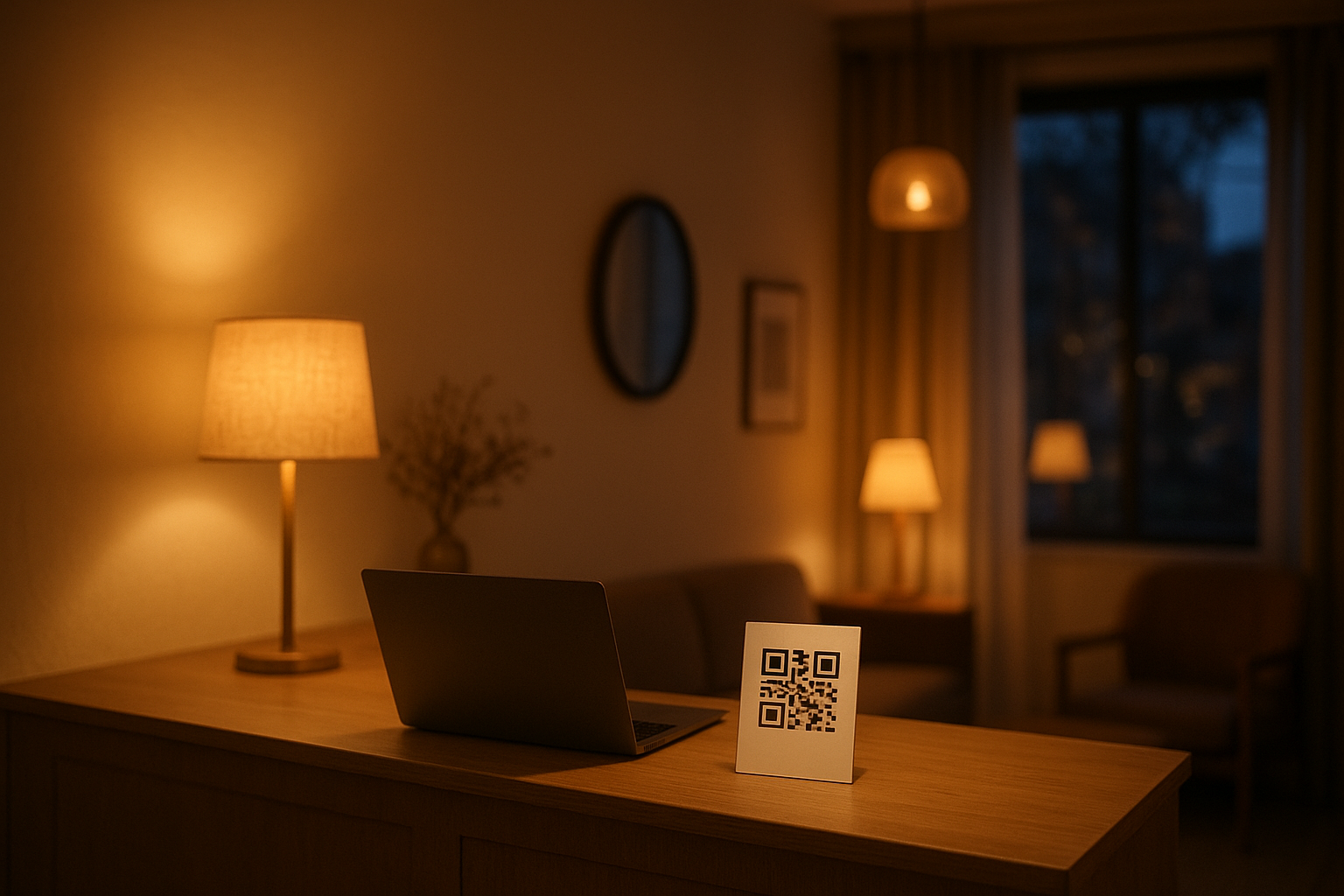
A simple QR code at check-in gives guests instant access to multilingual customer care in hotels without an app download.
Customer Care in Hotels Before Booking: Why Response Speed Decides the Sale
Long before a guest checks in, customer care in hotels is already being judged, through the speed and tone of the very first reply. A traveler comparing three similar boutique properties on an OTA will frequently book with whichever one answers a question first, especially when the question involves dates, accessibility, or a special occasion. In particular, lead-response research across industries consistently shows that replies delivered within minutes convert far better than replies that arrive hours later, and hospitality is no exception.
In practice, this means a property's pre-booking customer care needs to work across several channels at once: the hotel's own website chat, OTA messaging inboxes, social media direct messages, and the phone. Similarly, a guest who messages at midnight from a different time zone should not have to wait until the next business day for a basic answer about parking or pet policy. Where a large chain solves this with a 24-hour call center, an independent hotel typically cannot justify that cost, which is exactly why an AI-assisted, multilingual channel that can answer common pre-booking questions instantly, and hand off anything complex to staff, closes the gap without adding headcount.
In contrast, hotels that only prioritize in-stay service while leaving pre-booking inquiries to chance are leaving bookings, and revenue, on the table. Therefore, any serious strategy for customer care in hotels has to treat the pre-booking inbox with the same urgency as a guest standing at the front desk.
How Technology Is Changing Hotel Guest Service
Hotel guest service has traditionally relied on a phone, a radio, and a notepad at the front desk. In contrast, newer tools let guests message a property directly from their own phone, in their own language, without downloading anything. This matters because guest-facing hotel apps have a poor track record; industry research has long shown that only a small minority of guests ever install a hotel app for a one- or two-night stay.
Similarly, enterprise guest platforms built for large chains often assume a PMS (property management system, the reservation and room-management software a hotel runs on) integration project and a price tag sized for a 300-room hotel, which leaves most independents without a realistic option. For a deeper look at this shift, this guide to QR-code hotel concierge tools breaks down what to look for.
7 Steps to Stronger Customer Care in Hotels at Boutique Properties
Improving customer care in hotels does not require a full technology overhaul. Instead, most properties can follow a short, practical process that spans booking through checkout.
Audit every guest touchpoint, including pre-booking inquiries. Track the questions and requests your team answers in a typical week, from OTA messages and website chats to in-room requests, because most hotels discover a handful of repeat items drive most of the workload.
Map your language gaps. List the languages your recent guests actually speak, then compare that list against the languages your staff can comfortably support without relying on guesswork or outside translation apps.
Set a response-time standard for every channel. Decide, in writing, how quickly a pre-booking message, a phone call, and an in-room request should each be answered, then measure your team against that standard weekly.
Deploy a no-app guest channel for in-stay requests. Choose a tool guests can reach by scanning a QR code placed in the room, so they never need to download software or create an account just to ask for help.
Route requests to the right department automatically. Make sure a housekeeping request reaches housekeeping and a dining question reaches the right staff member, translated automatically into the language your team already works in.
Track response times and flag safety issues. Monitor how quickly requests get resolved and set up required-acknowledgment alerts for anything safety-related, such as a food allergy, so nothing depends on memory alone.
Review KPIs monthly and close the loop with guests. Look back at response times, resolution rates, and post-stay reviews together each month, then follow up with guests whose issues were not fully resolved before they leave a public review.
For a closer look at step one, see how boutique hotels rethink housekeeping workflows to cut wasted room visits. Likewise, properties juggling scattered guest requests can learn how to organize guest messages in one place instead of across texts, calls, and sticky notes.
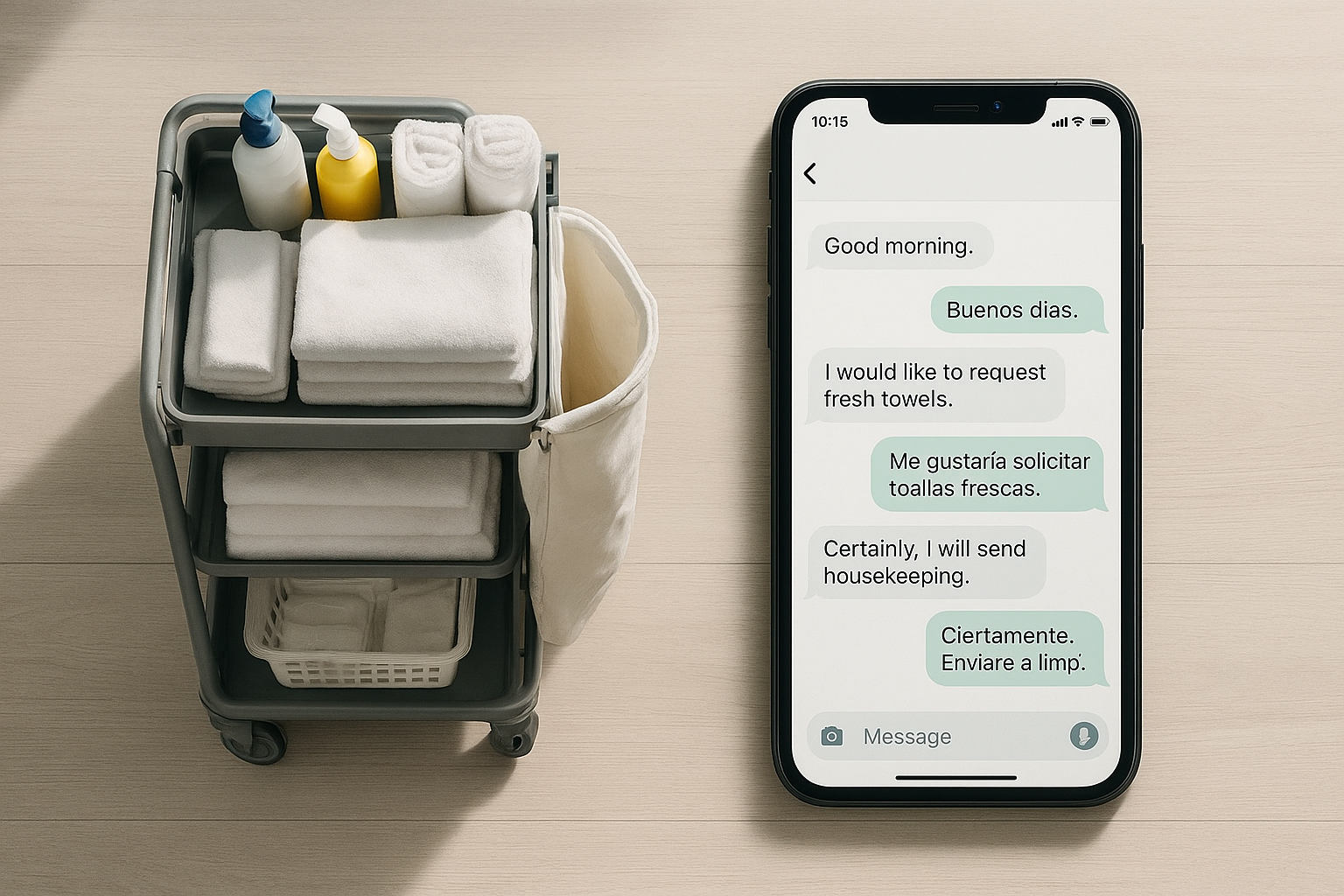
Routing requests straight to housekeeping, already translated, cuts wasted trips and missed service windows.
Handling Maintenance Issues Without Breaking Guest Trust
Few things test customer care in hotels like an out-of-order room during a sold-out weekend. Specifically, a broken air conditioner or a plumbing issue forces a fast decision: fix it quietly, relocate the guest, or offer a service recovery gesture, all while keeping other departments informed so nobody re-sells a room that is not ready. Therefore, properties need a clear, documented process for tracking which rooms are out of service and why. This guide to tracking and resolving out-of-order rooms fast walks through exactly how boutique hotels keep these situations from turning into bad reviews.
Similarly, a related friction point is the last-minute room change request, whether it is triggered by a maintenance issue or simply a guest wanting a better view. Properties looking to handle this smoothly can review how teams respond quickly to room upgrade requests once every request flows through a single dashboard instead of a notebook at the front desk.
Where Cortesia Fits: A Multilingual AI Concierge for Boutique Hotels
Cortesia approaches customer care in hotels by turning each guest's own phone into a private, branded concierge. Guests scan a QR code in the room, and no app, login, or guest account is required. Every message is answered in the guest's language and, at the same time, every request lands on one live staff dashboard translated into the language the team already works in.
Because there is no PMS integration to build, properties can go live in days. The platform supports eight languages end to end, including full right-to-left Arabic, with unlimited guest usage and unlimited staff seats. When a guest mentions a food allergy, Cortesia triggers a staff alert that requires acknowledgment, so the information cannot quietly disappear between the front desk and the kitchen. You can see how this works on a real property through the live demo of The Mesquite, a 42-room boutique hotel handling guests across eight languages, or the Henderson House example of a single Dallas rental run remotely.
Cortesia Compared With Other Guest Service Platforms
Not every guest-messaging tool is built the same way. Some rely on a texting-first model aimed at larger hotels with dedicated IT support, while others assume a native app guests must download, and still others are built primarily for vacation-rental hosts rather than hotels with a front desk. A side-by-side look, such as this comparison of Cortesia and Bellboy, is a useful way to weigh which model fits a smaller, owner-operated property rather than a large chain. In addition, properties evaluating guest-experience platforms built around rental management should see this detailed comparison between Cortesia and Duve before committing to a tool that may not match a boutique hotel's workflow.
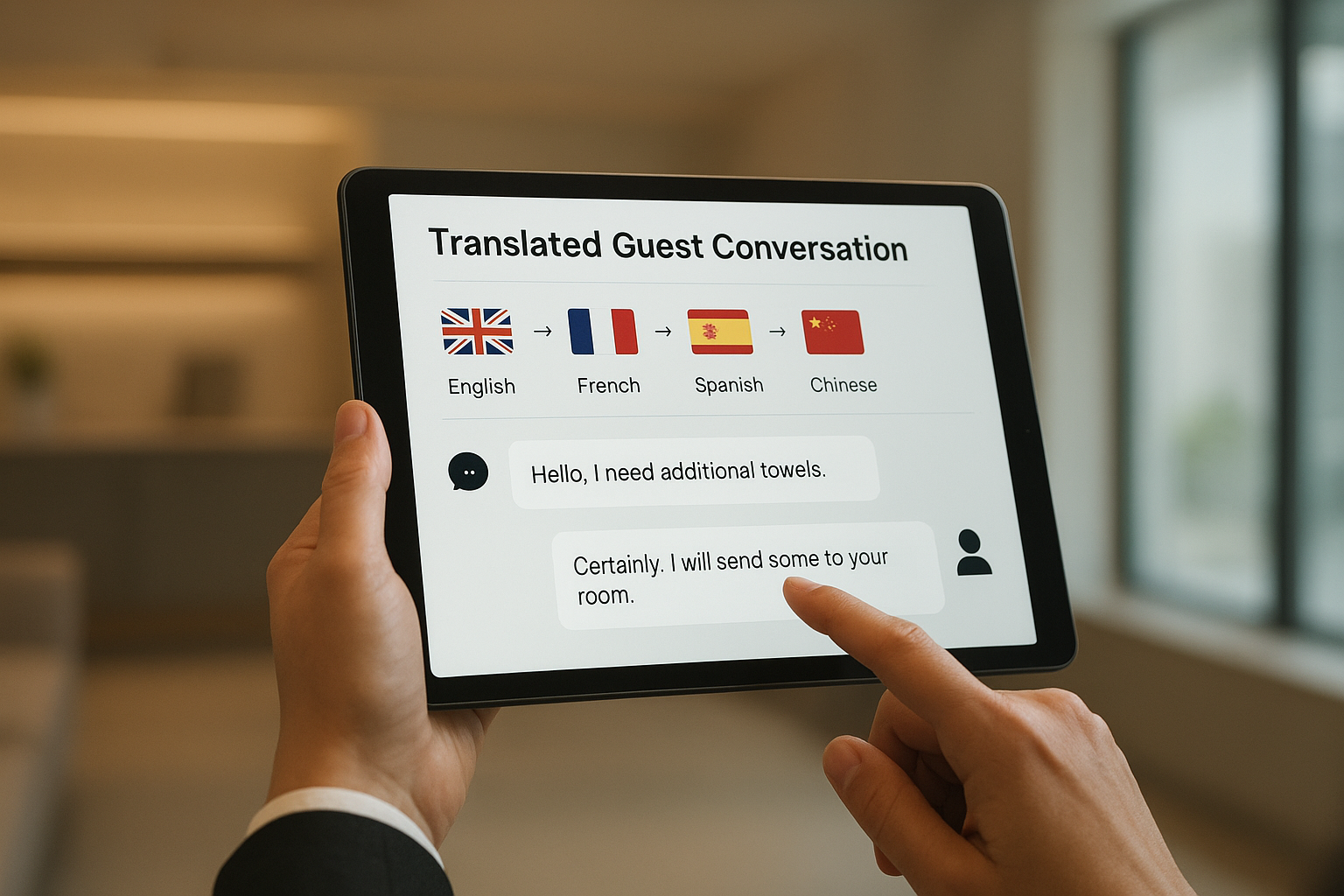
A single translated dashboard keeps every guest request visible to the whole team, regardless of language.
How to Measure Customer Care in Hotels: KPIs That Matter
Good intentions are not a strategy, so measurement matters. In particular, three numbers tell most of the story: average response time across all channels, the percentage of requests resolved on first contact, and guest satisfaction, often tracked as CSAT (customer satisfaction score, a simple rating guests give right after an interaction) or reflected in post-stay review scores. For background on the underlying concept, see customer satisfaction on Wikipedia.
Furthermore, independent properties should also track pre-booking response time separately, since a slow reply to an OTA inquiry can quietly cost bookings without ever showing up in a guest-satisfaction survey, because the traveler simply booked elsewhere. Reviewing these numbers monthly, rather than only after a bad review appears, helps a small team spot bottlenecks before they affect revenue.
Frequently Asked Questions About Customer Care in Hotels
What is customer care in hotels, exactly?
Customer care in hotels is the ongoing support guests receive from the first booking inquiry through checkout, including answering questions, resolving problems, and handling day-to-day requests like housekeeping or dining. It is measured by how quickly and accurately a hotel responds, not just by how guests are greeted at check-in.
How is customer care in hotels different from customer service in other industries?
Hotel customer care is continuous rather than transactional, since a single guest may generate several requests across one stay. Unlike a retail interaction, a hotel also has to track safety-relevant details, such as allergies, across an entire team and across multiple booking and communication channels.
Why do language barriers matter so much for guest experience?
A guest who cannot clearly explain a need in English is likely to give up or be misunderstood. Research from CSA Research found that 76% of consumers prefer to engage in their own language, which makes multilingual support a practical necessity rather than a nice-to-have.
What common mistakes hurt customer care in hotels?
The most common mistakes are relying on guest apps nobody downloads, letting pre-booking inquiries sit unanswered on OTAs, leaving in-stay requests scattered across texts and sticky notes, and failing to document safety details like food allergies. Each mistake slows response time and raises the risk of a bad guest experience.
How fast should hotels respond to a booking inquiry?
As a practical standard, independent hotels should aim to answer pre-booking questions within minutes during business hours and within a few hours overnight, since travelers comparing several properties often book with whoever replies first. Consequently, an automated first response that hands complex questions to staff helps small teams hit this standard consistently.
Which communication channels matter most for customer care in hotels before a guest books?
The channels that matter most are a hotel's own website chat, OTA messaging inboxes, social media direct messages, and the phone. In particular, properties that monitor all four consistently, rather than only the one that is easiest to check, capture more bookings from travelers who message instead of calling.
Does strong customer care in hotels really increase direct bookings?
Yes. A fast, helpful reply to a pre-booking question builds enough trust that many travelers will book directly through a hotel's own website instead of an OTA, which also reduces commission costs. In contrast, a slow or confusing reply often pushes the traveler back to comparison shopping.
How much does AI concierge technology cost for a small hotel?
Pricing models vary, but tools built for independent properties typically use simple per-room, month-to-month pricing rather than enterprise contracts. Cortesia, for example, charges per room with no long-term commitment and includes onboarding at no extra cost.
How long does it take to set up a digital concierge?
A no-app, QR-code based concierge can typically go live in days, not months, because it does not require a property management system integration. Setup usually includes building the property knowledge base, importing rooms and staff, and printing QR materials.
Do guests need to download an app to get good customer care in hotels?
No, with modern QR-based tools guests scan a code in the room and start chatting instantly, with no app, login, or guest account required. This removes the biggest barrier to adoption, since most guests never install a hotel app for a short stay.
How does Cortesia handle food allergies and safety concerns?
When a guest mentions a food allergy, Cortesia triggers a staff alert that requires acknowledgment, so the information cannot be lost between departments. This creates a record of who knew about the allergy and when they confirmed it.
How should hotels handle customer care in hotels when a room is out of order?
Properties should log the issue immediately, notify housekeeping and the front desk so the room is not re-sold, and offer the affected guest a clear alternative or gesture of goodwill. A documented tracking process, rather than a verbal handoff, prevents the same room from being double-booked twice in one week.
Can short-term rental hosts use the same approach as hotels?
Yes, hosts running a single property or a small portfolio can use the same QR-based concierge approach as hotels with a front desk. Cortesia's Henderson House demo, for instance, shows a single Dallas rental managed remotely by one owner.
What languages does Cortesia support?
Cortesia supports eight languages end to end, including full right-to-left support for Arabic. Guest messages are automatically translated into the language staff already use on the dashboard.
Is a PMS integration required to improve customer care in hotels with Cortesia?
No, Cortesia does not require a property management system integration to go live. This is a key reason properties can launch in days rather than the months typical of enterprise guest platforms.
How does Cortesia compare to platforms like Duve?
Cortesia is built around no-app, QR-code guest access and multilingual support with no PMS requirement, while other platforms often focus more heavily on upsell automation or require deeper system integrations. The full comparison of Cortesia and Duve breaks down which approach fits a boutique property versus a larger managed portfolio.
What is the best way to measure good customer care in hotels?
Track response time across every channel, the percentage of requests resolved on first contact, and whether safety-related items like allergies were acknowledged by staff. Reviewing these numbers monthly helps a small team spot bottlenecks before they show up in guest reviews.
Final Thoughts on Customer Care in Hotels
Customer care in hotels no longer depends on a bigger front-office team or a long technology rollout. Instead, lean properties can close the staffing gap by auditing every touchpoint from the first booking inquiry onward, mapping language needs, setting response-time standards, and routing guest messages to the right department automatically. In addition, pairing those habits with a simple, no-app concierge like Cortesia lets a boutique hotel or short-term rental answer guests in their own language, before and after booking, without adding headcount. Ultimately, the properties that get this right will keep winning on the personal service that set them apart in the first place.