
Room Upgrade Requests: How Boutique Hotels Respond Fast
A room upgrade request is one of the simplest things a guest can ask for, yet it's one of the easiest things for a lean hotel team to fumble, or for a traveler to ask for the wrong way. The request arrives by phone, by text, or at the front desk counter, and unless someone writes it down immediately, it can quietly vanish during a shift change. For boutique hotels that pride themselves on personal service, a mishandled room upgrade request is a small failure with an outsized effect on how a guest remembers the stay.
This problem gets worse when the guest asking does not speak the same language as the person behind the desk. A rushed, half-understood exchange about room categories and pricing is exactly the kind of moment that turns into a bad review. Meanwhile, on the guest side, many travelers simply don't know when or how to ask, so they either stay quiet or ask in a way that works against them. Fortunately, fixing both sides of this equation doesn't require a new front-desk hire, a long software rollout, or luck. Below, we cover the complete picture: how guests should ask, how hotels should respond, and the exact process that keeps a room upgrade request from falling through the cracks.
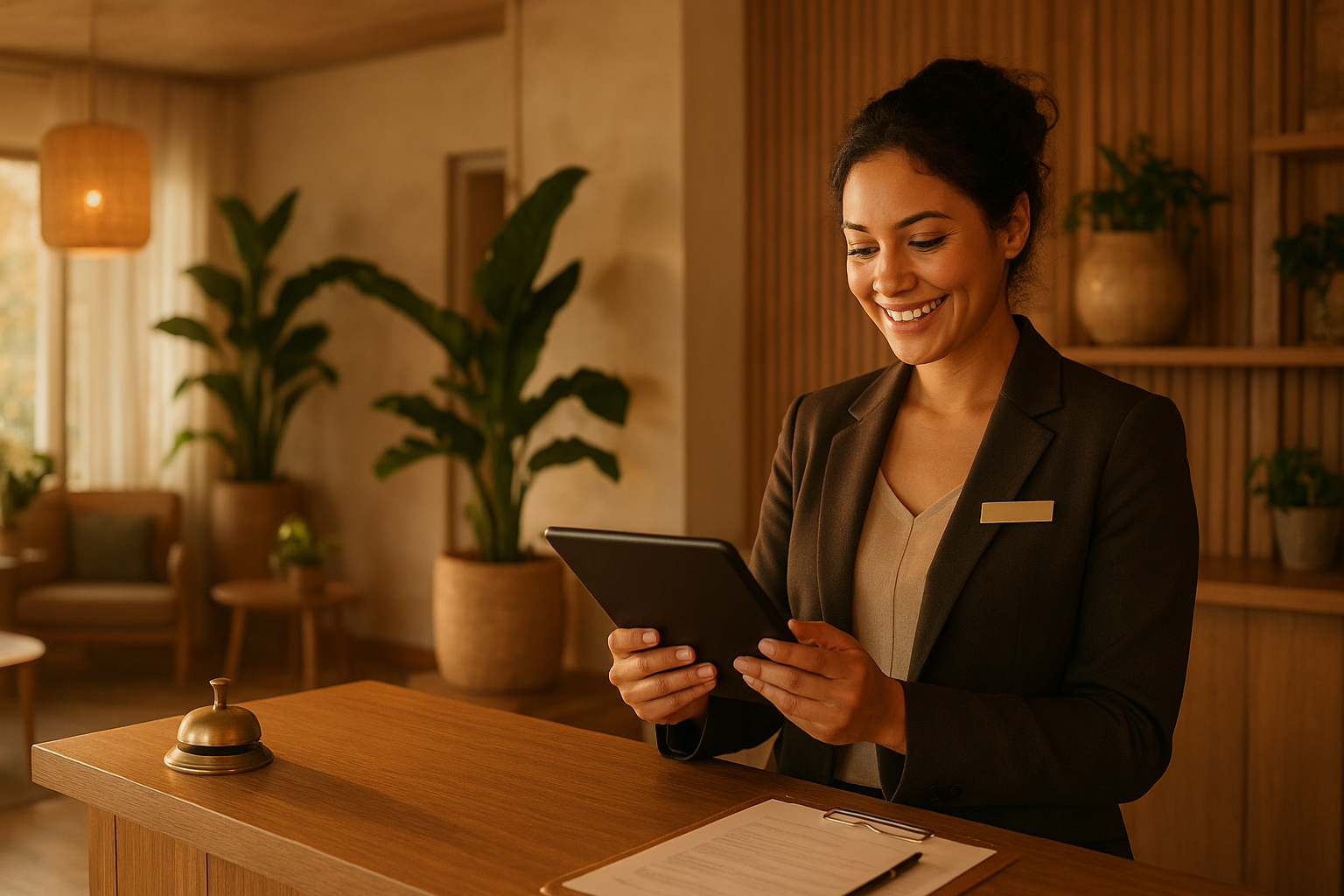
Front desk staff can confirm a room upgrade request in minutes when it arrives on a dedicated dashboard.
What Is a Room Upgrade Request?
A room upgrade request is simply a guest's ask to move from the room category they booked to a higher one: a suite, a room with a better view, or a floor with more space. It can happen before arrival, at check-in, or at any point during the stay once a better room becomes available.
Unlike a maintenance issue or a housekeeping request, an upgrade request almost always involves a price conversation. As a result, staff need to answer two questions at once: is there availability, and what does it cost? Getting either answer wrong, or getting it to the guest too slowly, undermines the personal service that boutique hotels depend on to compete with larger chains.
Why Upgrade Requests Are Hard for Lean Teams
Staffing shortages make this harder than it looks. According to an AHLA and Hireology survey, 65% of hotels report staffing shortages, with housekeeping and the front desk cited as the most critical gaps. When the same two or three people are answering Wi-Fi questions, checking guests in, and fielding upgrade requests, something inevitably gets dropped.
Consequently, upgrade requests tend to travel through whatever channel is fastest for the guest at that moment: a phone call, a text to a number found online, or a verbal ask while walking past the desk. None of those channels hold a reliable record, so when the staff member who heard the request goes off shift, the next person starts from zero. In some cases, a room that could have been upgraded sits empty simply because nobody closed the loop, the same kind of coordination failure that drives up costs when an out-of-order room isn't tracked properly either.
The Language Barrier Behind a Slow Room Upgrade Request
International travel has returned to record levels, with roughly 1.5 billion international arrivals recorded globally in 2025, according to figures tracked by the UN World Tourism Organization. A meaningful share of those travelers prefer not to conduct business in English. Specifically, research from CSA Research found that 76% of consumers prefer to engage with businesses in their own language, which includes asking for something as simple as a better room.
As a result, a guest who cannot clearly explain what kind of upgrade they want, or does not understand the price being quoted, often just gives up. The hotel never finds out it lost a small upsell, and the guest leaves with the impression that the property couldn't really help them. A multilingual guest app closes exactly this gap by letting the request and the response happen in the guest's own language, without anyone needing to call in a translator.
How to Ask for a Room Upgrade: 10 Tactics That Actually Work
Most advice on this topic stops at "be polite," which is true but incomplete. Below is the fuller picture of what actually moves the needle when a guest wants a better room.
Before You Arrive
Book directly through the hotel's own website or by phone. In particular, direct bookings make it far easier for staff to grant a complimentary upgrade than a request routed through a third-party travel site.
Join the hotel's loyalty program before you check in, even if you're a first-time guest. Many properties give a small preference boost to enrolled members when allocating same-day upgrades.
Mention a special occasion (a birthday, anniversary, or honeymoon) in the notes field of your reservation. Staff frequently flag these stays for a free upgrade when space allows.
Travel during shoulder season or midweek. Since occupancy runs lower on these dates, more upgraded rooms sit open and available to offer.
At Check-In
Check in during the late afternoon rather than first thing in the morning. By mid-afternoon, housekeeping has usually finished turning over rooms from early departures, so staff can see exactly what's actually available.
Ask the person checking you in directly, rather than emailing ahead. A face-to-face (or in-app) request is easier for staff to act on immediately than a message buried in an inbox.
Be specific about what you want (a higher floor, a view, extra space) instead of a vague "anything better." Specific requests are easier to match against real inventory.
Offer to pay a reasonable difference. A guest willing to pay for a partial upgrade is often easier to accommodate than one holding out for a free one.
If Your Room Upgrade Request Is Declined
Ask politely to be kept on a list in case a room opens up later. As covered below, hotels that log every request can revisit yours once an early checkout frees up space.
Stay friendly regardless of the outcome. Front desk staff remember guests who were gracious about a "no," and that goodwill often pays off on a future stay.
It's worth noting that many premium travel credit cards and hotel elite tiers advertise upgrade eligibility as a cardholder or loyalty perk. However, even with those benefits, confirmation still depends on same-day availability; no card or status tier can upgrade a guest into a room that's already occupied.
How Do Hotels Decide Who Gets a Room Upgrade?
Most hotels weigh three things: availability, loyalty status, and how clearly the request was made. In short, a guest who asks early and clearly often has a better shot than one whose request arrives garbled through a third party.
Boutique properties rarely have large loyalty programs to lean on, so availability and timing matter even more. A room that opens up because of an early departure is frequently offered to whichever guest asked first and asked clearly, regardless of how many previous stays they've logged. This is precisely why the mechanics of capturing the request matter just as much as the guest's approach: a clear system beats a lucky encounter at the desk.
The 5-Step Process for Handling a Room Upgrade Request in Real Time
A clear, repeatable process keeps room upgrade requests from falling through the cracks, regardless of who's on shift. The steps below reflect how boutique hotels using a QR-based guest concierge, such as the setup shown in the Cortesia live demo property, typically handle the request from the moment a guest asks to the moment it's logged.
Capture the request where the guest already is. Let the guest send the room upgrade request from their own phone, for example by scanning a room QR code, instead of requiring a trip downstairs or a phone call that might go unanswered.
Route it to the right staff member instantly. The request should land on whoever is on duty, translated into the language the team works in, rather than sitting in a shared inbox nobody checks regularly.
Check availability and confirm the price. Staff verify which upgraded rooms are open and whether a fee applies before replying, so the guest gets one accurate answer the first time.
Reply in the guest's own language. The confirmation or decline goes back in the language the guest used to ask, cutting the risk of a mix-up about price or room type.
Log the outcome for the next shift. Whether confirmed, declined, or pending, the result gets written down so nobody has to ask the guest to repeat themselves later.
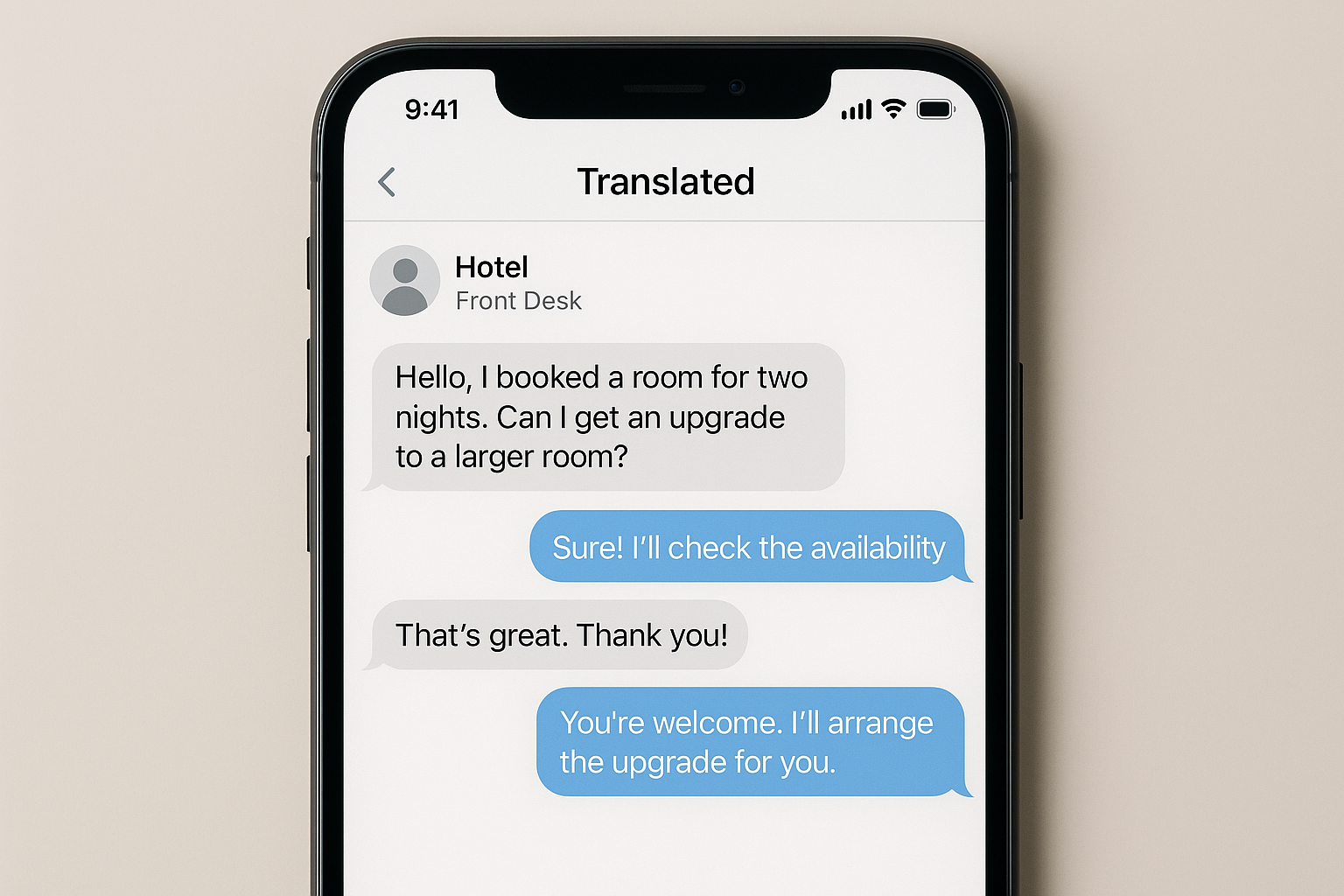
A translated chat thread keeps a room upgrade conversation accurate from first ask to final confirmation.
A Sample Room Upgrade Request Script for Staff
Having a ready-made script removes the guesswork for new or part-time staff. For example:
Guest: "Is there any chance we could get a room with a better view?"
Staff: "Let me check what's available for your dates. We have a junior suite open with a $35 difference per night; would you like me to confirm that for you?"
Notice that the script names the room type, states the price plainly, and asks for explicit confirmation before anything is changed. Using the same wording every time, in every language the property serves, keeps the experience consistent no matter who's behind the desk.
Common Reasons a Room Upgrade Request Gets Denied
Even a perfectly worded request sometimes gets turned down. Understanding why helps set realistic expectations on both sides of the desk.
No inventory is available. If every upgraded room is already sold or occupied, there's simply nothing to move the guest into.
The room is blocked for an arriving guest. Hotels often hold upgraded rooms for VIPs or loyalty members arriving the same day.
The room is out of service. A maintenance issue can quietly remove an otherwise-available upgrade from the pool entirely.
The request arrived too late. A request made minutes before checkout leaves staff no time to prepare the room.
Choosing a Guest Communication Tool for Room Upgrade Requests
Many independent hotels now compare guest messaging platforms before picking one, since the wrong tool can add more friction than it removes. For instance, some platforms require a native app download, while others assume a deep property management system integration that takes months to configure. Before committing, it's worth reading a broader guest messaging software buyer's guide to understand what questions to ask vendors.
Side-by-side comparisons help clarify the tradeoffs. Teams evaluating options often review how Cortesia compares to Bellboy, how it stacks up against Cloudbeds, and how the approach differs from Duve, Canary Technologies, and Akia. Each comparison focuses on setup time, language support, and whether a PMS connection is required before a property can go live.
Best Practices for Managing Upgrade Requests
A few habits separate hotels that handle upgrade requests smoothly from those that lose track of them. Above all, consistency matters more than any single tool.
Write down every request immediately, even ones that seem informal or unlikely to be approved.
Confirm the price verbally or in writing before the guest moves rooms, not after.
Share the request across shifts so a departing staff member doesn't take the context with them.
Reply in the guest's language whenever possible, even if that means using a translation tool.
Flag related needs, such as allergies or accessibility requirements, at the same time as the upgrade.
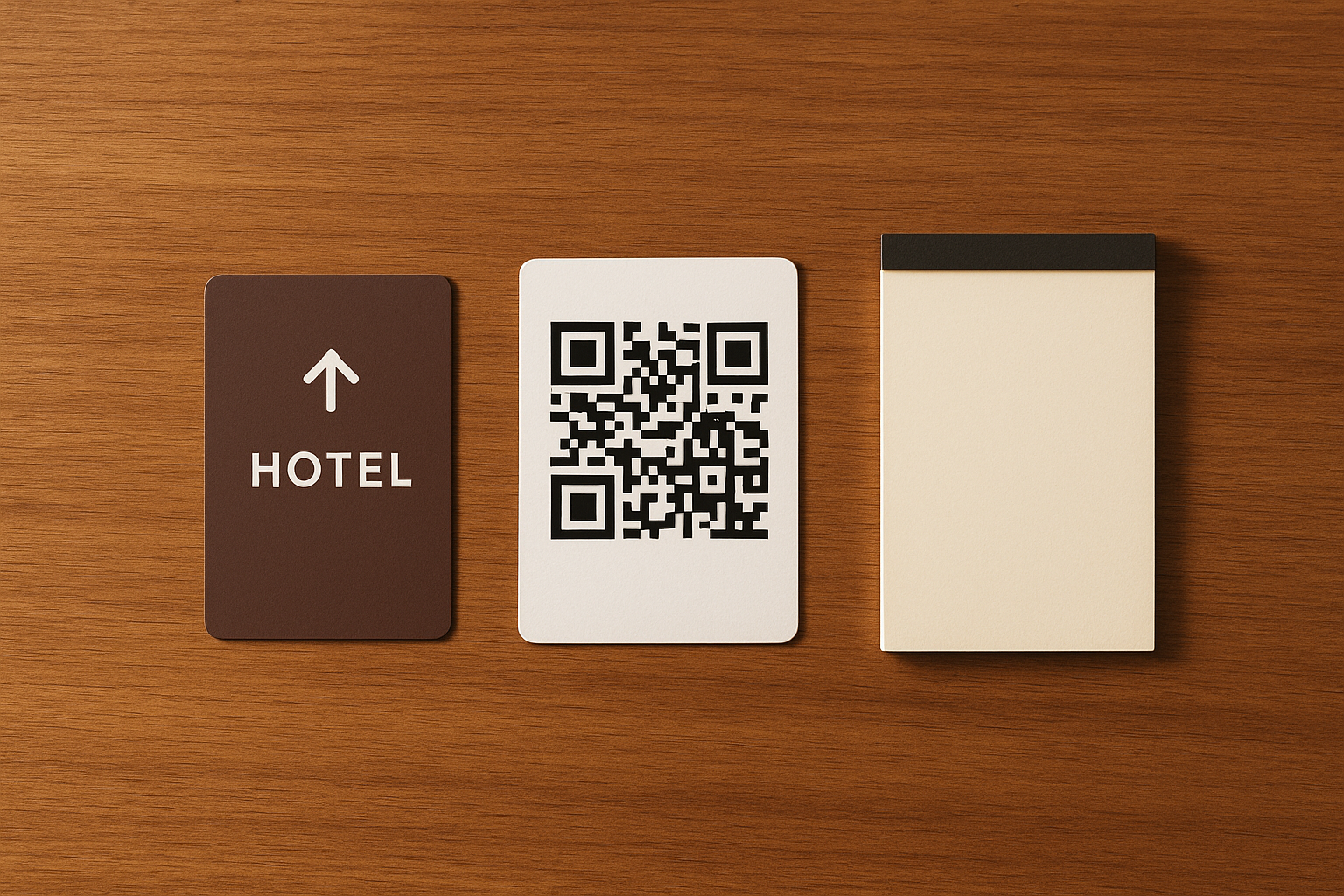
A printed QR code lets a guest send a room upgrade request without downloading anything.
Room Upgrades for Short-Term Rentals
Short-term rental hosts face a slightly different version of the same problem. Since most rentals don't have a front desk, an upgrade request usually means moving a guest to a different unit the host manages, not a different room in the same building.
Even so, the core need is identical: a fast, clear way for the guest to ask and for the remote host to confirm. A single-property host juggling messages across text, email, and a booking platform inbox benefits just as much from a centralized, translated request log as a 100-room hotel does. In both cases, the hotel concierge function, whether human or digital, exists to remove exactly this kind of friction.
Frequently Asked Questions About Room Upgrade Requests
What is a room upgrade request?
A room upgrade request is a guest's ask to move from their booked room category to a higher one, such as a suite or a room with a better view. It can happen before arrival, at check-in, or at any point during the stay.
How do hotels decide who gets a room upgrade?
Hotels typically weigh availability, loyalty status, rate paid, and how the request was made. A guest who asks clearly and early often has a better chance than one whose request gets lost in a phone queue.
Is a room upgrade request always free?
No, many upgrades carry a fee based on the rate difference between room categories. Some boutique hotels offer complimentary upgrades when occupancy is low or as a loyalty gesture.
Why do language barriers slow down room upgrade requests?
When a guest cannot clearly explain what they want in the staff's working language, the front desk has to guess or ask the guest to repeat themselves. Each step adds delay and increases the chance of a misunderstood request.
Can guests request a room upgrade without going to the front desk?
Yes, many boutique hotels now let guests send upgrade requests through a QR code concierge tool from their own phone. The request lands directly on a staff dashboard instead of waiting in a phone or lobby queue.
What is the best time to ask for a room upgrade?
Asking at check-in or shortly before arrival usually works best, since staff can see same-day availability clearly. Asking mid-stay is also fine if a better room opens up after another guest checks out early.
How long does it take a hotel to confirm a room upgrade?
With a digital concierge routing the request directly to the right staff member, confirmation often happens within minutes. Without one, a request stuck in a phone queue can take hours or get missed entirely.
What mistakes do hotels make with room upgrade requests?
Common mistakes include letting requests sit unanswered, forgetting to confirm the price before upgrading, and failing to log the request for the next shift. Losing track of who asked and when is one of the most frequent complaints.
Do short-term rentals handle room upgrade requests differently than hotels?
Short-term rentals usually have fewer unit types, so an upgrade request often means moving to a different property the host manages rather than a different room. A remote host still needs a fast way to receive and confirm that request.
How can boutique hotels compete with big chains on room upgrades?
Boutique properties can respond faster and more personally because decisions don't pass through a large hierarchy. Fast, multilingual acknowledgment of an upgrade request often matters more to guests than loyalty-tier perks.
What technology helps hotels manage room upgrade requests?
A guest-facing tool that routes requests straight to staff, translated in real time, removes the phone-tag and sticky-note problem. QR-based concierge platforms let guests ask for an upgrade from their own device without downloading an app.
Should a room upgrade request be logged even if it is declined?
Yes, logging every request, including declined ones, helps staff follow up if a room opens later and protects the hotel if the guest raises it again. A shared record also prevents one shift from repeating work another shift already did.
Can a room upgrade request include special needs like allergies or accessibility?
Yes, guests often combine an upgrade request with a related need, such as a higher floor for quiet or a room near an elevator. Hotels should flag these details so housekeeping and front desk both see them.
What is the difference between a room upgrade and an amenity upgrade?
A room upgrade changes the physical room category, such as moving from a standard room to a suite. An amenity upgrade adds extras, like late checkout or a welcome gift, without changing the room itself.
Does credit card status guarantee a room upgrade request will be approved?
No. Premium cards and elite loyalty tiers can make a hotel more willing to prioritize a guest, but approval still depends on same-day room availability. A request made clearly and early tends to matter more than the card in a guest's wallet.
Final Thoughts on Room Upgrade Requests
A room upgrade request is a small moment, but it carries outsized weight for how a guest remembers their stay. On the guest side, asking clearly, asking early, and staying gracious consistently beats any single trick. On the hotel side, capturing the request quickly, confirming the price clearly, and replying in the guest's own language turns a simple ask into a reason to leave a great review. Meanwhile, hotels that let a room upgrade request bounce between a phone, a sticky note, and a shift change risk losing both the upsell and the goodwill.
For boutique and independent properties with lean teams, the fix doesn't require a large technology project. A straightforward process, backed by a tool that routes and translates requests in real time, is usually enough to handle every room upgrade request as well as any larger chain. Properties exploring their options can review the live demo and setup details at cortesia.ai to see how the process looks in practice.