
Hotel Guest Messaging Software: A 2026 Buyer's Guide
Hotel guest messaging software turns every guest request, a spare towel, a late checkout, a broken thermostat, into a written, trackable conversation that staff can answer in seconds instead of minutes. For boutique and independent hotels, however, speed is only half the equation. The real test is whether a guest who speaks German, Spanish, or Japanese gets the same fast, accurate answer as a guest who speaks English. This guide breaks down exactly what hotel guest messaging software needs to do in 2026, compares it against PMS-bundled messaging add-ons and traditional front-desk tools, and shows what a modern, multilingual option like Cortesia looks like in practice.
Direct answer: Hotel guest messaging software replaces phone calls, radios, and paper notes with a single digital channel where guests text requests and staff reply from one shared dashboard. The strongest versions for independent hotels add automatic translation, safety alerts, and same-day setup with no required PMS integration, the exact features most enterprise-first tools skip.
What Is Hotel Guest Messaging Software?
Hotel guest messaging software is a communication platform that gives guests a direct, written channel to reach hotel staff and gives staff a shared inbox for managing those requests. Instead of a guest calling the front desk and hoping someone picks up, the guest sends a message that lands wherever a staff member is watching, whether that's the front desk, housekeeping, or the kitchen.
Consequently, the category has grown well beyond simple text-back tools. Today's platforms often add automatic translation, request routing, upsell automation, and knowledge bases so the software can answer common questions on its own, escalating only what genuinely needs a human. In other words, modern guest communication platforms are closer to a lightweight AI concierge than a glorified SMS inbox.
Specifically, the technology sits in three places at once: a guest-facing entry point (a QR code, link, or app), a translation and automation layer, and a staff-facing dashboard. Each piece matters, and weakness in any one of them undermines the whole system, a point many buyers discover only after a rollout stalls.
Why Boutique Hotels Need a Guest Messaging Platform
Independent hotels are being asked to deliver more personal service with fewer people, and staffing is the pressure point. In fact, an AHLA and Hireology survey found that 65% of hotels report staffing shortages, with housekeeping and the front desk named as the most critical gaps.
As a result, the front desk becomes a bottleneck. Staff spend their shift repeating Wi-Fi passwords, breakfast hours, and checkout times, while the phone keeps ringing and the guest at the counter waits. Meanwhile, language barriers quietly damage the stay. Research from CSA Research shows that 76% of consumers prefer to engage in their own language, and international travel has returned to record levels, with roughly 1.5 billion international arrivals expected in 2025 according to the UN World Tourism Organization. A guest who cannot explain an allergy or a broken air conditioner in English either gives up or gets it wrong, and that gap is exactly what a true hotel guest messaging platform is built to close.
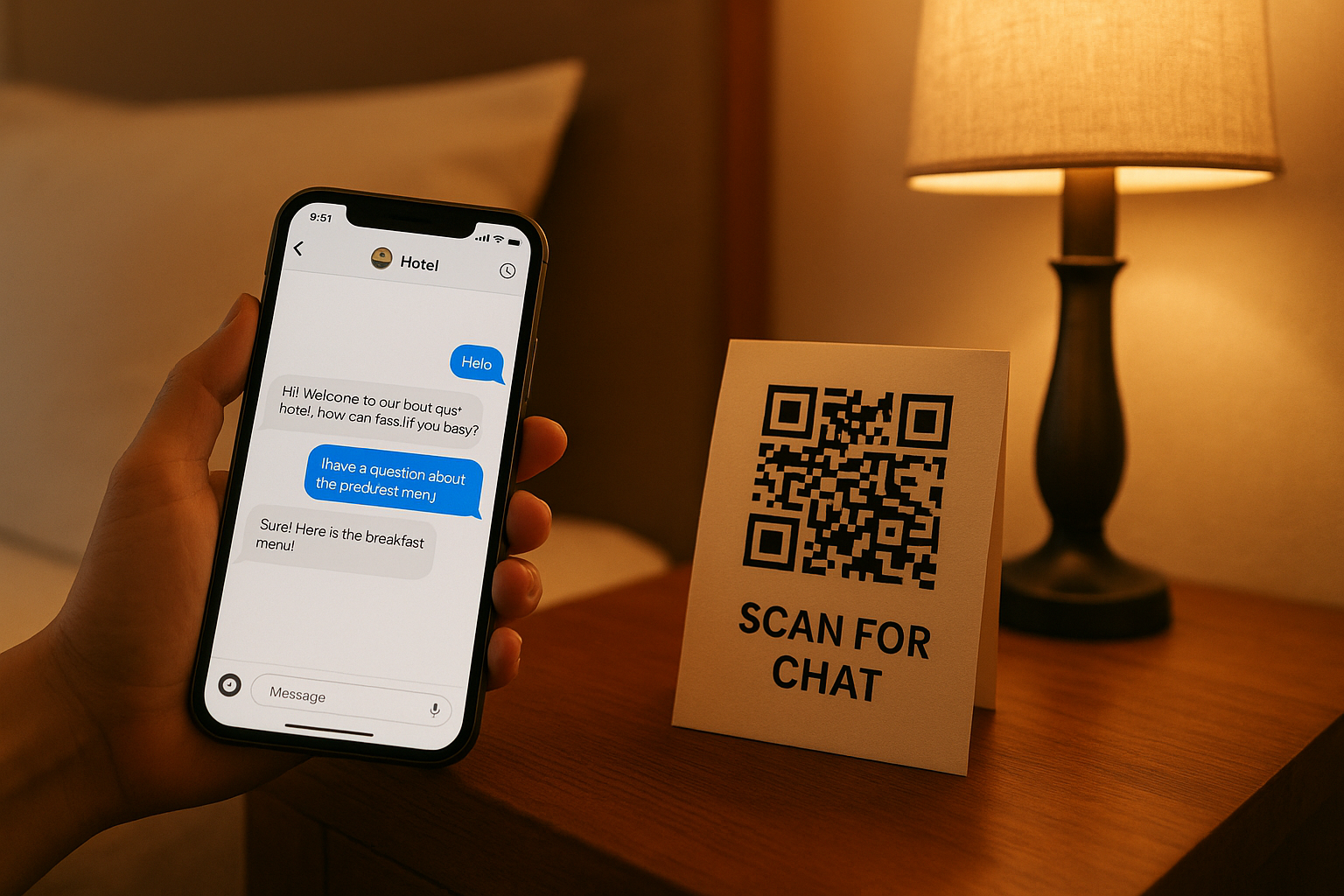
Hotel guest messaging software often starts with a simple room QR code, no app required.
Core Features Every Hotel Guest Messaging Platform Needs
Not every guest communication platform is built for a 30-room boutique property. When comparing options, a handful of features separate tools that genuinely fit independents from tools designed around a large chain's IT department.
No app, no login: Guests should reach the platform by scanning a code, not by creating an account for a two-night stay.
Real translation, not just multilingual menus: The software should translate full conversations, not just a static welcome screen.
No required PMS integration: A property management system integration project can add months to a rollout that should take days.
Department routing: A request about a broken faucet should reach maintenance directly rather than sit in a general inbox; see this breakdown of how to organize guest requests fast for a deeper look at routing logic.
Safety alerts: Allergy or safety-related messages should trigger something staff must acknowledge, not just a notification that can be dismissed.
Multi-channel delivery: SMS, WhatsApp, web chat, and QR entry points should all feed the same inbox so no channel becomes a blind spot.
Analytics and reporting: Response-time data and recurring-question trends should be visible without exporting to a spreadsheet.
How Hotel Guest Messaging Software Works, Step by Step
In practice, getting hotel guest messaging software running follows a predictable sequence. Here is what that setup typically looks like for an independent property or a short-term rental.
Build the property knowledge base. Amenities, menus, Wi-Fi details, house rules, and local recommendations get loaded in so the software can answer routine questions from day one without staff intervention.
Import rooms and staff. Every room or unit is added, and staff are assigned to departments like front desk, housekeeping, and food and beverage so requests reach the right person automatically.
Print and place QR codes. Print-ready QR codes go on the nightstand, desk, or bathroom mirror where guests naturally look; for a full walkthrough, see this QR code hotel concierge guide for boutique hotels.
Go live and monitor the dashboard. Staff watch the live dashboard for incoming requests and refine the knowledge base as new questions show up during the first week.
Train staff and set response benchmarks. A short training session on response-time targets, typically under five minutes for urgent requests, turns the software into a habit rather than a novelty.
Because there is no native app to build and no PMS integration project, properties using platforms like Cortesia can typically go live in days rather than months.
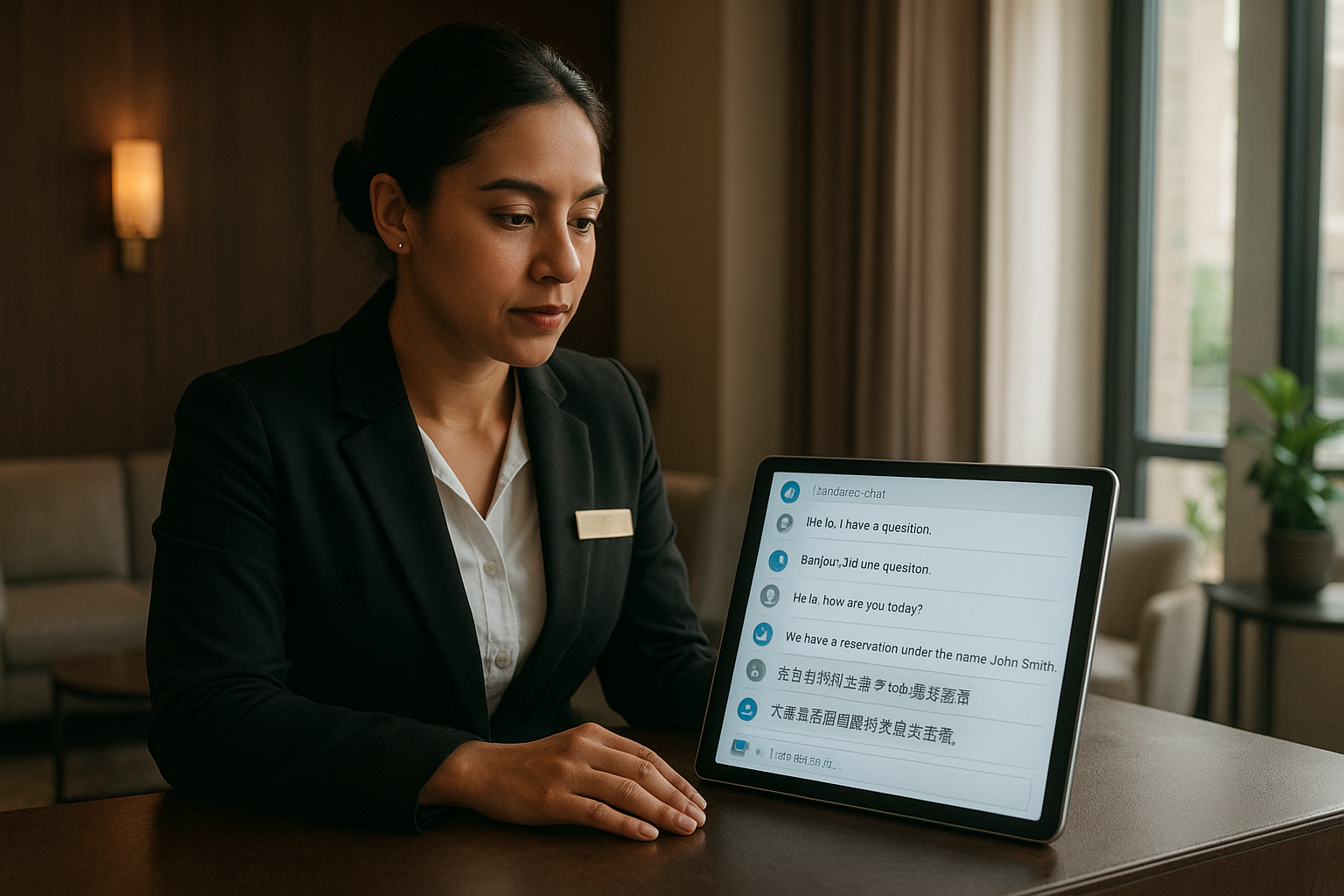
A live, translated staff dashboard keeps every guest request organized in one place.
Hotel Guest Messaging Software vs. Traditional Front Desk Tools
Traditional front desk tools (phone systems, radios, and paper logs) were never designed for written, multilingual guest requests. They work, but they leave no searchable record and no automatic routing. For a closer, feature-by-feature look at the difference, see this comparison of Cortesia against traditional front desk tools.
In contrast, dedicated guest messaging software captures every request in writing, timestamps it, and routes it to the right person automatically. That difference matters most during a busy check-in rush, when a missed call can mean a guest waits twenty minutes for an answer that a message could deliver in two.
Hotel Guest Messaging Software vs. PMS-Bundled Messaging Add-Ons
A separate category worth understanding is the messaging module bundled inside a larger property management system. These add-ons can be convenient if a property already runs that specific PMS, but they come with trade-offs that independents should weigh carefully before buying.
Specifically, PMS-bundled messaging usually requires the property to already be subscribed to that vendor's full platform, which locks the hotel into one ecosystem for reservations, payments, and communication alike. Furthermore, translation in these bundles tends to cover only a handful of major languages rather than the eight-plus languages an international guest mix actually needs, and safety-critical alerts like allergy flags are rarely a core feature. In contrast, a standalone hotel guest messaging software platform can sit alongside whatever PMS, booking engine, or spreadsheet a property already uses, which matters enormously for the many independents that are not ready to replace their entire tech stack just to fix guest communication.
Factor | Standalone Messaging Software | PMS-Bundled Add-On | Traditional Front Desk Tools |
|---|---|---|---|
Setup time | Days | Weeks to months | Immediate, but no digital record |
PMS required | No | Yes, usually that vendor's suite | No |
Languages supported | Often five to eight-plus, full conversation translation | Typically limited to two or three | None |
Safety alerts | Common, with required acknowledgment | Rarely a core feature | Manual only |
Comparing Popular Guest Messaging Platforms
Several established platforms serve the hospitality market, and each takes a different approach to size, integration, and pricing. Reviewing them side by side helps clarify which fits a boutique property rather than a large chain.
See how Cortesia compares with Akia, a guest messaging tool often built around SMS workflows.
Review the difference between Cortesia and Cloudbeds, a broader property management suite.
Compare Cortesia against Canary Technologies, which focuses on upsells and digital authorizations.
Look at Cortesia versus Bellboy, another concierge-style messaging option.
Above all, the right choice depends on room count, guest language mix, and how much integration work the property is willing to take on.
Cortesia: Multilingual Guest Messaging Built for Independents
Cortesia is the multilingual AI concierge built specifically for boutique and independent hotels and short-term rentals, typically 10 to 150 rooms. Guests scan a QR code in their room and get instant answers, service requests, and local knowledge in their own language, with no app, no login, and no front-desk queue.
Every request lands in one live staff dashboard, translated for the team, covering eight languages end to end, including full right-to-left Arabic. Setup includes the property knowledge base, room and staff import, and print-ready QR materials, and food-allergy mentions trigger staff alerts that require acknowledgment. Pricing is simple per-room, month-to-month, with unlimited guest usage and unlimited staff seats, cancel any time. Owners can explore a live example at the Cortesia demo or learn more at cortesia.ai.

Short-term rental hosts rely on hotel guest messaging software just as much as full-service properties do.
Guest Messaging Channels: SMS, WhatsApp, Email, and QR Codes
Guests do not all reach out the same way, so a strong guest texting platform should not force a single channel. Instead, it should let a guest pick whatever feels natural: scanning a room QR code, texting a number from a booking confirmation, opening WhatsApp, or replying to a pre-arrival email.
That said, channel variety only helps if every channel feeds the same staff dashboard. Otherwise, a request sent by WhatsApp might get missed because staff were only watching the SMS inbox. For properties curious about the lowest-friction entry point, a QR code hotel concierge guide for boutique hotels walks through why QR-first design tends to get the highest guest adoption of any channel, since it requires no typing of a phone number and no app-store detour.
Automation, AI Auto-Replies, and Upsell Messaging
Beyond basic texting, the more advanced guest messaging platforms use automation to answer repetitive questions instantly and to surface revenue opportunities at the right moment. For example, a guest asking about checkout time might also see an automatic, non-pushy offer for a late checkout upgrade, while a guest asking about dinner options might see a reservation link for the hotel's own restaurant.
Similarly, room-upgrade requests are one of the highest-value conversations a messaging platform can automate, since a quick, accurate answer often converts faster than an email sent hours later. For a detailed look at handling these requests well, see how boutique hotels respond fast to room upgrade requests. Above all, automation should reduce staff workload, not replace judgment on anything safety-related or unusual.
Guest Data Security and Privacy Compliance
Because guest messaging software stores personal details, room numbers, and sometimes payment-adjacent conversations, data handling deserves real scrutiny before signing a contract. At minimum, a platform should encrypt messages in transit and at rest, limit staff access by role, and provide a clear data-retention policy.
In addition, properties serving European or California guests should confirm the vendor's approach to consumer privacy rights, since regulators increasingly expect businesses to document how personal data is collected and deleted; the FTC's privacy and security guidance is a useful starting reference for US-based properties evaluating any guest-facing software. Ultimately, a vendor that cannot explain its data practices in plain language is a vendor worth questioning further.
Measuring ROI: Metrics That Prove Guest Messaging Software Works
Buying the software is only step one; proving it earns its keep is step two. Several metrics make that case clearly within the first 60 to 90 days.
Average response time: Track how quickly staff acknowledge a request, especially during check-in and check-out peaks.
Call volume at the front desk: A drop here usually means guests are self-serving routine questions through the knowledge base instead.
Review mentions of service: Compare online review language before and after rollout for words like "fast," "responsive," or "helpful."
Upsell conversion rate: Measure how many automated upgrade or amenity offers convert compared with staff-only upselling.
Staff task completion: Properties running a dedicated hotel staff task management software alongside messaging often see faster closure rates, since routed requests convert directly into trackable tasks.
Common Mistakes to Avoid When Choosing Hotel Guest Messaging Software
The most common mistake is picking a tool built for large chains that assumes a PMS integration and a big IT budget. Another is choosing a platform that only translates a handful of languages, which still leaves some guests without real support.
Furthermore, properties sometimes treat messaging as a standalone tool rather than part of a connected workflow. In contrast, pairing messaging with proper task routing, as described in this 2026 buyer's guide to hotel staff task management software, ensures a guest message actually becomes a completed job, not just a read receipt.
Frequently Asked Questions About Hotel Guest Messaging Software
What is hotel guest messaging software?
Hotel guest messaging software is a system that lets guests contact staff by text or chat, usually through a QR code or link, instead of calling the front desk. Staff manage every conversation from one dashboard rather than juggling phones, radios, and paper notes.
How does hotel guest messaging software work for multilingual guests?
The best platforms translate the guest's message into the staff's working language and translate the staff reply back into the guest's language automatically. This means a Spanish-speaking guest and an English-speaking front desk agent can have a full conversation without either side switching apps.
Why do boutique hotels need hotel guest messaging software instead of relying on phone calls?
Phone calls interrupt whoever answers and leave no record for the next shift. Messaging software captures every request in writing, routes it to the right department, and gives owner-operators a searchable history if a problem needs review later.
How is hotel guest messaging software different from a hotel guest app?
A guest app requires a download, an account, and often a login, which most guests skip during a short stay. Modern guest messaging software works through a browser after a QR code scan, so there is nothing to install and no account to create.
What does hotel guest messaging software cost for a small property?
Pricing varies widely, but independent-friendly platforms typically charge a simple per-room monthly fee rather than enterprise contracts. Cortesia, for example, uses month-to-month per-room pricing with unlimited guest usage and unlimited staff seats included.
How long does it take to set up hotel guest messaging software?
Platforms that skip PMS integration and native app development can go live in days rather than months. Setup usually involves loading the property's knowledge base, importing rooms and staff, and printing QR materials for each room.
What common mistakes do hotels make when choosing guest messaging software?
The most common mistake is picking a tool built for large chains that assumes a PMS integration and a big IT budget. Another is choosing a platform that only translates a handful of languages, which still leaves some guests without real support.
Does hotel guest messaging software require a PMS integration?
No, not always. Several platforms, including Cortesia, are designed to work without a PMS integration so independent properties can launch quickly instead of waiting on a lengthy technical rollout.
Can hotel guest messaging software handle food allergy alerts?
Good guest messaging software should flag safety-critical messages, such as a food allergy, so staff cannot miss or forget them. Cortesia, for instance, triggers a staff alert that requires acknowledgment whenever a guest mentions an allergy.
What languages should hotel guest messaging software support?
Coverage should match the property's actual guest mix, which for many independents and border or gateway cities means at least five to eight languages. Full right-to-left language support, such as Arabic, matters for properties serving Middle Eastern travelers.
Is hotel guest messaging software useful for short-term rentals?
Yes, arguably more so, since short-term rentals often have no front desk at all. A remote host can still answer questions instantly and route urgent issues without being on-site.
What best practices help hotels get the most from guest messaging software?
Place QR codes where guests naturally look, such as the nightstand and bathroom mirror, and train staff to respond within a set time window. Review conversation logs weekly to spot recurring questions worth adding to the knowledge base.
Which messaging channels does hotel guest messaging software support: SMS, WhatsApp, or QR code?
Strong platforms support multiple entry points at once, including QR code scans, SMS, WhatsApp, and web chat, while routing every reply into the same staff dashboard. QR entry tends to get the highest guest adoption since it needs no phone number or app download.
Is guest data safe with hotel guest messaging software?
It should be, provided the vendor encrypts messages in transit and at rest, restricts staff access by role, and publishes a clear data-retention policy. Properties serving European or California guests should confirm the vendor's consumer privacy practices before signing a contract.
Can hotel guest messaging software increase upsell revenue?
Yes. Automated prompts tied to common guest questions, such as a late checkout offer triggered by a checkout-time question, often convert faster than staff-initiated upselling because the offer arrives at the exact moment the guest is already thinking about it.
Final Thoughts on Choosing Hotel Guest Messaging Software
Choosing the right hotel guest messaging software ultimately comes down to matching the tool to the property, not the other way around. A 42-room boutique hotel with guests in eight languages needs a very different setup than a 300-room chain with an IT department, and forcing an enterprise or PMS-bundled platform onto a lean team usually backfires.
In summary, look for software that skips the app download, skips the PMS integration project, translates full conversations rather than a static menu, and proves its value through measurable response-time and upsell data. Whether the property is a full-service boutique hotel or a single short-term rental managed remotely, the goal is the same: every guest gets a fast, accurate answer in their own language, and every request lands where staff can actually see it. Platforms like Cortesia, built specifically around those constraints, show what hotel guest messaging software looks like in practice for independents that compete on personality and service rather than scale.