

Instant Guest Service Chat for Hotels: A Full Guide
Instant guest service chat for hotels is a system that lets guests message the property in real time, from their own phone, in their own language, without downloading an app or creating an account. For a boutique or independent property, that single change removes most of the daily noise at the front desk. Instead of a guest standing at the counter or calling repeatedly, a request lands directly on a staff dashboard and gets answered fast.
Quick answer: Instant guest service chat for hotels lets a guest scan a QR code, open a chat in their phone's browser, and ask a question or make a request in their own language. The message is translated and routed to the right staff member, so there is no app, no login and no wait at the front desk.
Instant guest service chat for hotels moves routine questions away from the front desk counter.
What Is Instant Guest Service Chat for Hotels?
In short, it is a digital concierge that lives on a guest's own phone instead of on hotel hardware. A guest scans a printed QR code placed in the room, the lobby or a common area, and a private, branded chat opens immediately. From there, the guest can ask about checkout time, Wi-Fi, breakfast hours or a local recommendation, and receive an answer in their own language within seconds.
Unlike a general website chatbot, this chat is tied to a specific stay. Therefore, staff always know which room or unit a request is coming from. In addition, every message a guest sends in their own language arrives on the staff side already translated into the language the team works in, so nobody has to guess what was meant.
Why Lean Teams Need a Digital Concierge
Boutique and independent hotels compete on personality, not on scale. However, that personal touch depends on a front desk and housekeeping team that are often stretched thin. According to a survey from the American Hotel & Lodging Association and Hireology, 65% of hotels report staffing shortages, with housekeeping (38%) and the front desk (26%) named as the most critical gaps.
As a result, the same ten questions, Wi-Fi passwords, checkout times, restaurant hours, get answered over and over while other guests wait. A digital concierge absorbs that repetitive load. Specifically, it answers routine questions instantly and only escalates to a real person when a guest needs something staff must handle directly, such as a maintenance issue or a special request.
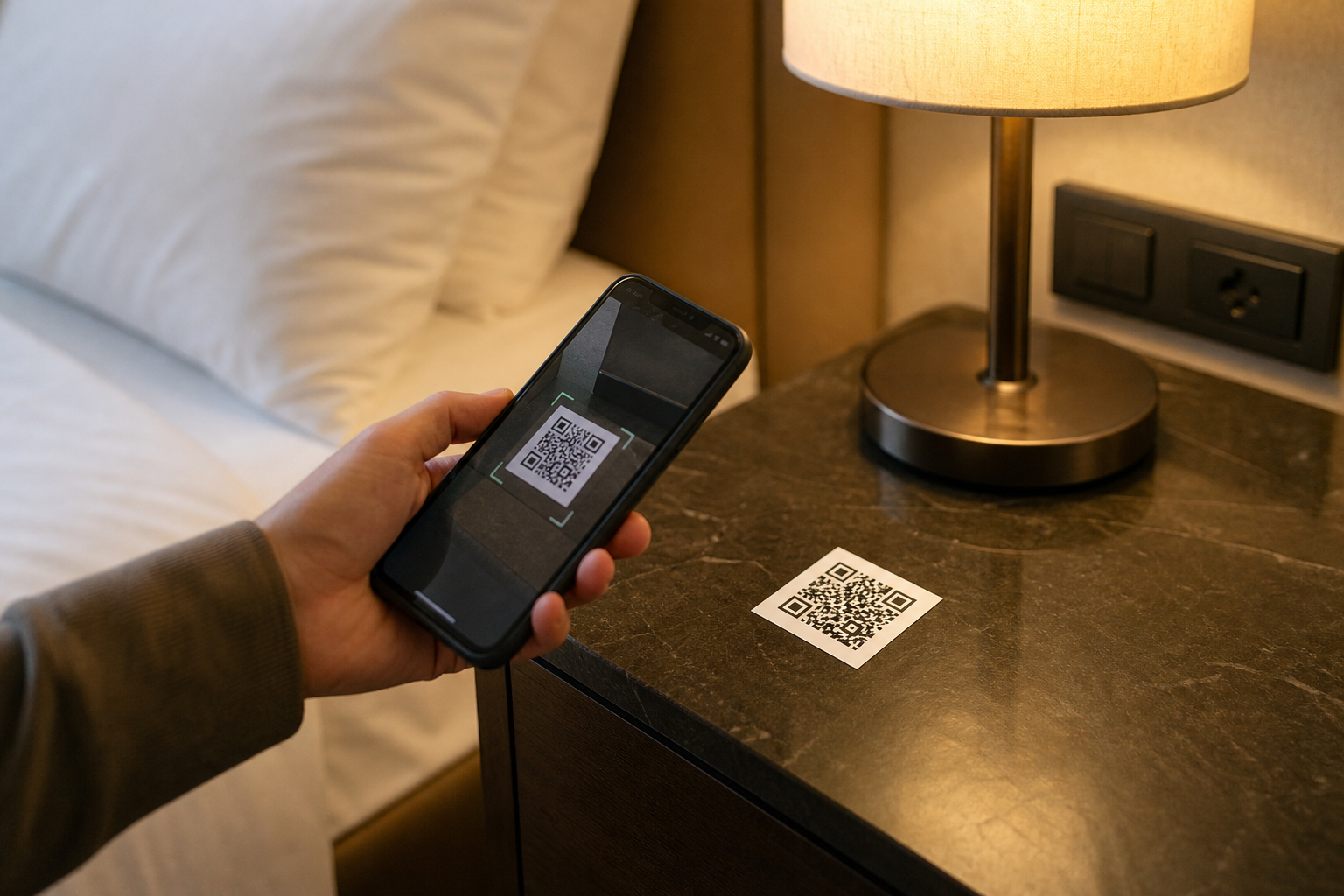
No app, no login: scanning the room QR code is the only step a guest needs.
How Real-Time Guest Messaging Works
The flow is simple on purpose. A guest opens the chat, types or speaks a question, and the system answers using what it knows about the property: room details, amenity hours, menus and local information. If the request needs a person, for example a late checkout or an extra towel, it is translated and sent to the right department in real time.
Consequently, housekeeping no longer knocks on a door hoping the guest is ready, and the front desk is not interrupted by a call that could have been answered automatically. Every request also lands in one place, which matters because scattered texts, sticky notes and radio calls are where requests get lost in a busy property.
For a closer look at how properties organize incoming requests once chat is in place, see this guide on organizing hotel guest messages efficiently.
Setting Up Instant Guest Service Chat in Days
One reason boutique hotels can move quickly here is that there is no property management system integration to plan around. The rollout generally follows five steps:
Map the property knowledge base. Load room details, amenity hours, Wi-Fi steps, local recommendations and house rules so the concierge can answer guest questions correctly from day one.
Import rooms and staff. Add every room number and assign requests to the right department, such as front desk, housekeeping or maintenance, so nothing gets lost between shifts.
Print and place QR codes. Generate branded, print-ready QR codes for each room, the lobby and common areas, so guests can open the chat without installing anything.
Go live and monitor the dashboard. Launch the concierge, watch requests arrive on one live staff dashboard translated into the language staff use, and respond in real time.
Review and refine. After the first week, check which questions guests ask most and update the knowledge base so answers stay accurate as the property changes.
Because none of these steps depend on hardware installation or a lengthy technical project, most properties are live in days rather than months. For a step-by-step look at QR-based setup specifically, see this QR code hotel concierge guide for boutique hotels.
Language Barriers and the Guest Experience
Language is where a good stay quietly turns into a bad review. A guest who cannot explain a broken air conditioner or a billing question in English often just gives up, or gets the wrong answer. In particular, CSA Research has found that 76% of consumers prefer to engage with a business in their own language, a preference that applies just as strongly inside a hotel as it does on a shopping website.
In addition, international travel has returned to record levels in recent years, which means more properties, especially in gateway cities, resort towns and areas near universities or convention centers, are hosting guests who do not speak the staff's primary language. Instant guest service chat for hotels addresses this directly: the guest types in their own language, and staff reply in the language they work in, with no misunderstanding in between.
Allergy and Special Requests: Staff Stay in Control
Allergy mentions deserve particular care. When a guest raises a food allergy inside the chat, the message triggers an alert that requires staff acknowledgment, so it cannot be missed or forgotten in a busy shift. However, this is a safety net, not a substitute for judgment.
Staff preparing food remain the final authority on allergies and food safety, and guests should always confirm allergy details directly with staff before eating. The chat's role is simply to make sure that information reaches the right person quickly and is logged, rather than mentioned once and lost.
Instant Chat vs Hotel Chatbots and Guest Apps
It helps to see how this compares with the two alternatives most hotels already know.
Approach | Install Needed | Typical Use |
|---|---|---|
Guest app | Download, login, account | Rarely opened after check-in |
Website chatbot | None, but pre-stay only | General booking questions |
Instant QR guest chat | None | In-stay requests, routed to staff |
Website chatbots are useful before arrival, but they are not built for in-stay service tied to a specific room. Guest apps, meanwhile, ask for a download for what is often a two or three night stay, and industry data has long shown only a small minority of guests ever install one. For a deeper comparison of chatbot features and costs, see this breakdown of how hotel chatbots work, including features and costs.

Multilingual guests benefit most from instant guest service chat for hotels during check-in and early in the stay.
Choosing a Guest Service Chat Platform
When comparing platforms, look closely at setup time, how languages are handled, and whether a PMS integration is actually required. Cortesia, for example, is built specifically for boutique and independent hotels and short-term rentals, with no required PMS integration, unlimited guest usage, unlimited staff seats, and simple per-room pricing that is month-to-month with onboarding included.
Setup covers the property knowledge base, a full room and staff import, and print-ready QR materials, so a 10 to 150-room property or a single short-term rental can be live in days. If you are evaluating named alternatives directly, this comparison of Cortesia and GuestAI walks through the practical differences. You can also see the approach firsthand at cortesia.ai.
Frequently Asked Questions
What is instant guest service chat for hotels?
Instant guest service chat for hotels is a system that lets guests message the property in real time, from their own phone, in their own language, without downloading an app or creating an account. Requests go straight to the right department instead of waiting at the front desk.
How does instant guest service chat for hotels work for guests?
A guest scans a QR code in the room or a common area, a chat window opens in their phone's browser, and they type a question or request in their own language. The message is translated and routed to staff automatically.
Do guests need to download an app to use it?
No. There is no app to download and no login or guest account to create. The chat opens directly in the phone's browser right after a QR scan.
How long does it take a hotel to set up guest chat?
Properties typically go live in days, not months, since there is no required PMS integration or hardware installation. Setup covers the property knowledge base, room and staff import, and print-ready QR materials.
How many languages can guests use with Cortesia?
Cortesia supports eight languages end to end, including full right-to-left Arabic. Guests type or speak in their own language, and staff read every request translated into the language they work in.
Does instant guest chat replace front desk or housekeeping staff?
No. Instant guest service chat for hotels does not replace staff. It routes requests to the right team, such as front desk, housekeeping or maintenance, so people spend less time repeating answers and more time on service.
How does the system handle allergy and food safety questions?
Food allergy mentions trigger an alert that requires staff acknowledgment, so the request is never missed. Staff preparing food remain the final authority on allergies and food safety, and guests should always confirm allergy details directly with staff.
What happens to guest data and privacy?
Guests never create an account, and the chat runs no analytics or advertising trackers. Allergy information is collected only to support guest safety and is shared with staff who need it to respond.
How is instant guest chat different from a hotel chatbot?
A website chatbot usually answers general pre-stay questions for anyone browsing the site. In contrast, instant guest service chat for hotels is built for in-stay use, tied to a specific room, and connects guests to a live staff dashboard for real requests.
How is it different from a hotel guest app?
Guest apps require a download, an install and often a login, and industry research shows only a small share of guests ever install one. Instant guest chat opens in the browser after a QR scan, so there is nothing to install.
Can short-term rental hosts use instant guest service chat too?
Yes. A single host managing a home or a few units remotely can use the same QR-based chat to answer guest questions and handle requests without a physical front desk.
What does it cost to add guest chat to a property?
Cortesia uses simple per-room pricing on a month-to-month basis, with onboarding included and no long-term contract required. Exact pricing depends on property size, so it is best confirmed directly with Cortesia.
What is a common mistake properties make when adding guest messaging?
The most common mistake is treating setup as one-time work. Properties that keep the knowledge base updated as menus, hours and amenities change see far fewer repeat questions than properties that set it up once and forget it.
Does instant guest service chat require integrating with a PMS?
No. Cortesia does not require a property management system integration, which is a major reason boutique and independent properties can go live in days instead of months.
Final Thoughts
Instant guest service chat for hotels is, above all, a practical fix for a staffing problem that is not going away soon. Boutique and independent properties cannot easily hire their way out of a tight labor market, but they can remove the repetitive questions and language barriers that eat up a front desk's day. By letting guests ask for help in their own language and routing every request to staff in real time, a small property can keep the personal service it is known for, without adding headcount or waiting months for a technology rollout.