
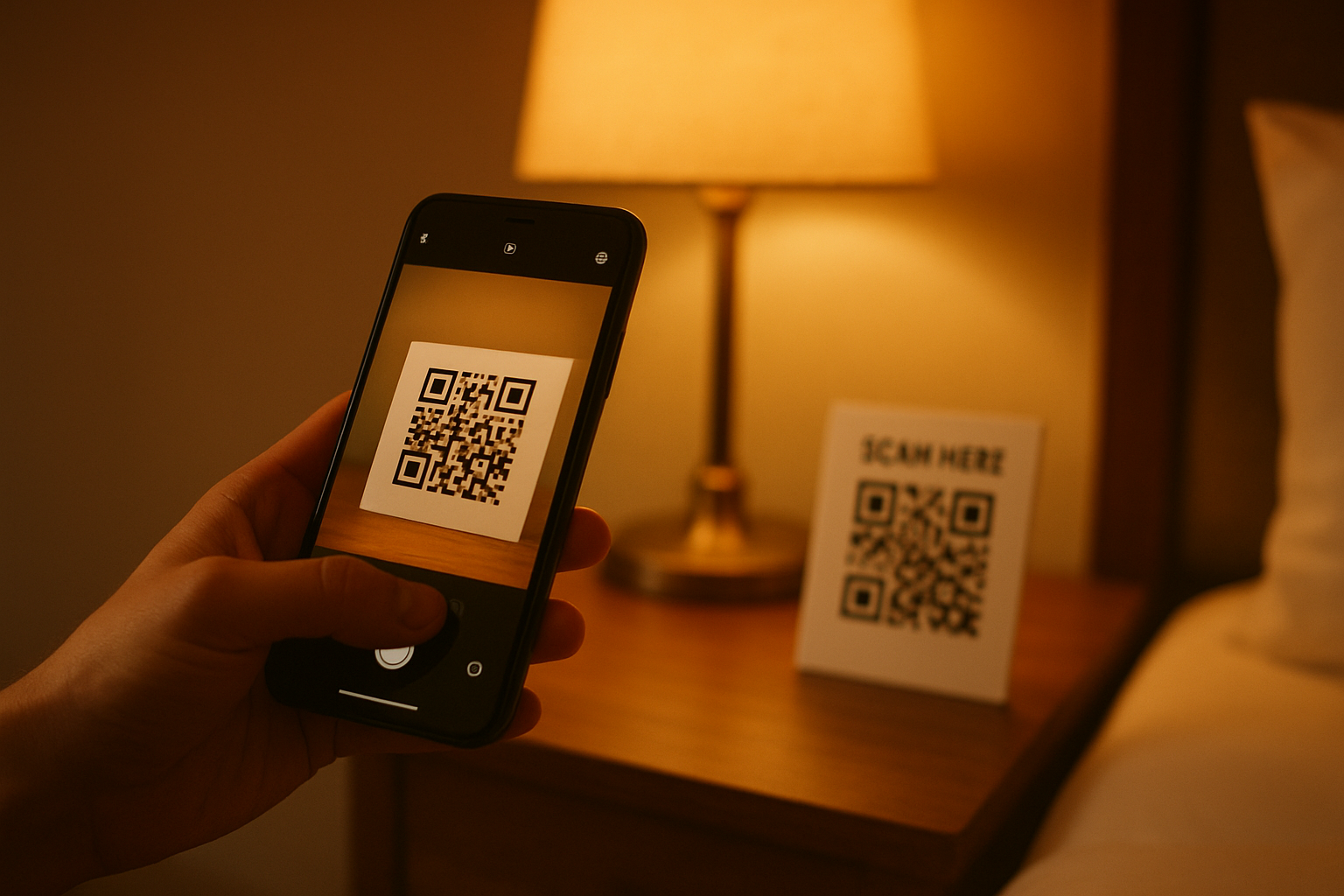
AI Concierge for Hotels: Complete Guide & Benefits
An AI concierge for hotels is software that answers guest questions, logs service requests, and routes them to the right staff member automatically, usually through a QR code or text message, in whichever language the guest already speaks. For boutique hotels, independent inns, and short-term rental operators running lean teams, this is no longer an experimental gadget. It has become one of the fastest, cheapest ways to protect service quality while headcount stays flat.
In the sections below, you will find exactly how an AI concierge for hotels works from the first scan to the resolved request, how it stacks up against SMS tools, native apps, and generic GPT chatbots, what it actually costs, and the mistakes that sink a rollout before it starts. Unlike a quick product pitch, this guide walks through every stage of the decision, so you can finish reading and know precisely what to do next.
A single QR code turns any guest's own phone into an AI concierge for hotels: no download, no account, no waiting.
What Is an AI Concierge for Hotels, Exactly?
At its core, an AI concierge for hotels is a guest-facing assistant that lives outside the front desk. Guests reach it by scanning a printed code or texting a number, and from there it answers routine questions (Wi-Fi passwords, breakfast hours, checkout times) while forwarding anything that needs a human to the correct department.
Unlike a native mobile app, it requires no download, no account creation, and in most cases no property management system integration project to launch. Guests simply point a camera, tap a link, and start typing in whichever language they already think in. Behind the scenes, Cortesia translates every guest message for staff and every staff reply back for the guest, supporting eight languages end to end, including full right-to-left Arabic, so a Spanish-speaking traveler and an English-speaking housekeeper can resolve a request without either one switching tongues.
How an AI Concierge for Hotels Differs From a Generic GPT Chatbot
A generic GPT chatbot (short for Generative Pre-trained Transformer, the technology behind tools like ChatGPT) answers from broad internet training data. That is useful for general conversation, but it is risky for a hotel, because it can confidently invent a checkout time or a policy that does not exist. A purpose-built AI concierge for hotels, by contrast, is trained only on the property's own knowledge base: real menus, real amenities, real local recommendations. As a result, answers reflect the actual hotel rather than a plausible-sounding guess.
Furthermore, a true AI concierge for hotels closes the loop with staff. A chatbot widget typically ends the conversation with an answer. A concierge platform, however, routes anything it cannot answer to a live, translated staff dashboard, so nothing important falls through a chat window and disappears.
Why Independent Hotels Need an AI Concierge for Hotels Right Now
Staffing pressure is the root cause, and it is not improving on its own. According to a survey by the American Hotel & Lodging Association and Hireology, 65% of hotels report staffing shortages, with housekeeping (38%) and the front desk (26%) named as the most critical gaps. Meanwhile, guest expectations have not dropped just because the team got smaller.
65% of hotels report staffing shortages. 76% of travelers prefer their own language. Roughly 1.5 billion international trips happen every year. An AI concierge for hotels was built to sit at the intersection of all three.
The Language Gap That Is Costing Hotels Reviews
Language adds another layer of risk that staffing alone does not explain. Research from CSA Research found that 76% of consumers prefer to engage in their own language, and international travel has returned to record levels, with roughly 1.5 billion international arrivals recorded in 2025 according to the UN World Tourism Organization. Consequently, a guest who cannot explain an allergy or a broken air conditioner in English is one misunderstanding away from a one-star review.
Why Native Guest Apps Never Delivered on Their Promise
Downloadable apps have not solved either problem. Industry research has long shown only a small minority of guests ever install a hotel's own app for a two-night stay, which is precisely why the no-download model, delivered through a QR code or a text message, has become the practical alternative for independent properties. If your team is still deciding between formats, our complete QR code hotel concierge guide breaks down placement, printing, and guest adoption in more depth.
How an AI Concierge for Hotels Works, Step by Step
The flow is intentionally short, so guests never feel like they are filling out a form. Here is exactly what happens from the moment a guest opens the door to the moment their request is resolved.
Scan the QR code or text the number. The guest scans a code placed in the room, on a key card, or in the welcome guide, which opens a private branded chat in their own language, with no app download or login required.
Ask a question or make a request. The guest types a question, such as breakfast hours or a late checkout request, in their own language, and receives an instant answer pulled from the property's knowledge base.
The request is translated and routed. When staff action is needed, the message is automatically translated and sent to the correct department (front desk, housekeeping, or food and beverage) inside a live staff dashboard built for exactly this handoff.
Staff acknowledge and resolve it. Staff respond in the language they work in, and any food-allergy mention triggers a required acknowledgment alert, so critical information is never missed between shifts or departments.
The guest gets a reply in their language. The loop closes without a phone call, a knock on the wrong door, or a repeat trip down to the front desk counter.
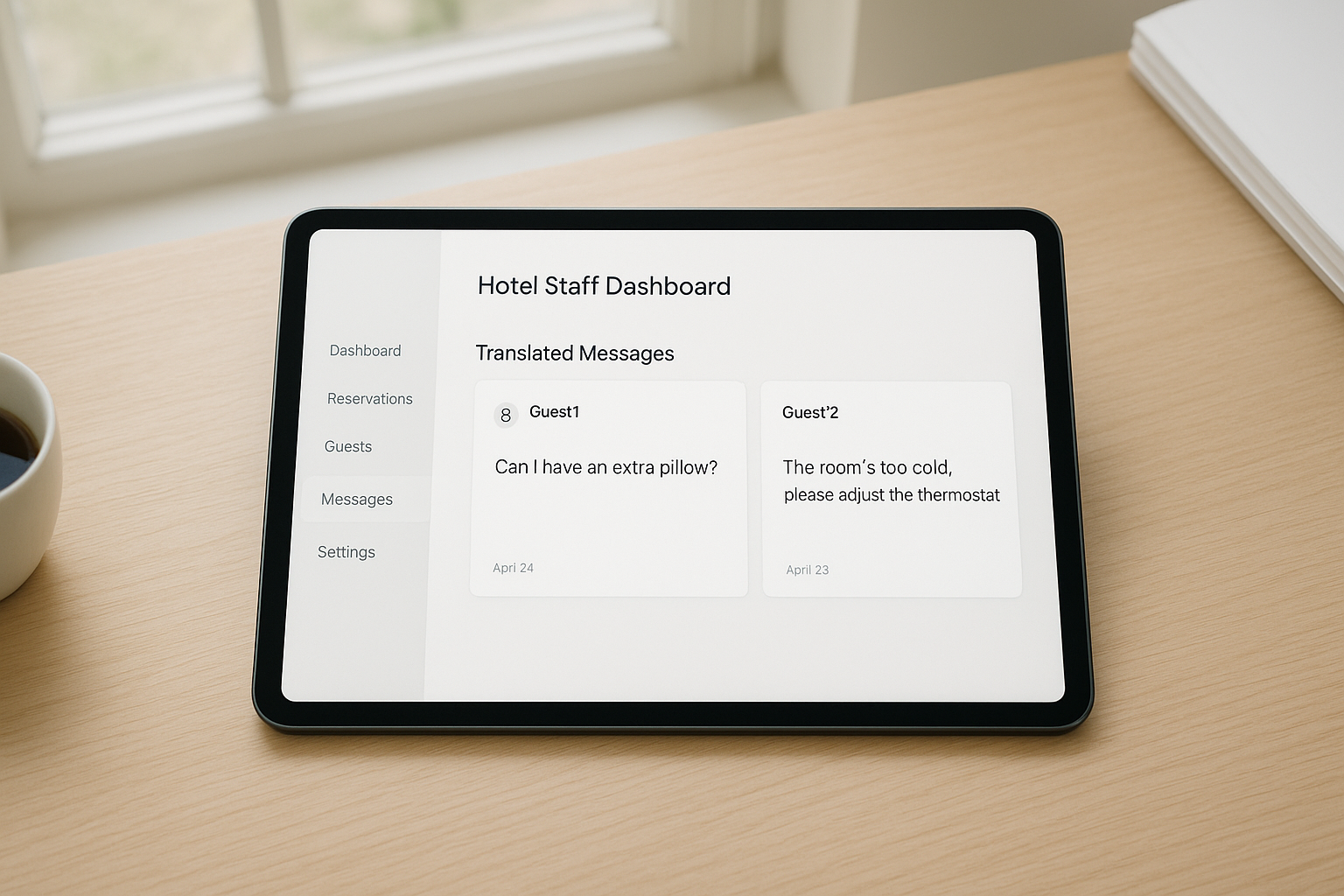
Every guest request lands on one live, translated dashboard instead of scattered texts and sticky notes. See how teams organize hotel guest messages fast once requests stop living in three different inboxes.
AI Concierge for Hotels vs SMS, Native Apps, and Generic Chatbots
Not every "smart concierge" solves the same problem. Some tools are really SMS marketing platforms with a chatbot bolted on; others are generic GPT widgets with no hotel-specific training. The table below compares the four formats hotels evaluate most often.
Format | Guest Effort | Language Handling | Staff Workflow |
|---|---|---|---|
AI concierge for hotels (QR/SMS) | Scan or text, no install | Translated both directions automatically | One live, routed dashboard |
SMS-only text concierge | Low, but texts get lost in threads | Often English-only or basic translation | Manual reading of raw text threads |
Native guest app | High: download, account, login | Varies by vendor | Usually tied to a PMS project |
Generic GPT chatbot widget | Low, but answers can be unreliable | Depends on the underlying model | No routing to specific departments |
In short, the format matters less than whether the tool is trained on the hotel's real knowledge base and connected to a workflow staff actually use. An AI concierge for hotels that combines QR or SMS access with a translated, routed dashboard checks both boxes at once.
Key Benefits of an AI Concierge for Hotels
Independent hotels typically see value in three broad areas: revenue, operations, and guest experience. Each one maps directly back to the staffing and language problems described above.
Revenue Benefits: Upsells and Ancillary Spend
Because the concierge is already in a guest's hand during the stay, it is also a natural place to surface a room upgrade, a late checkout, or a spa add-on at the exact moment a guest is thinking about it. For example, our breakdown of how boutique hotels respond fast to room upgrade requests shows how a translated, instant reply turns a passing question into booked ancillary revenue instead of a missed opportunity.
Operational Benefits: Staff Time Saved
Fewer repetitive front-desk interruptions. Wi-Fi passwords, breakfast hours, and checkout times get answered automatically, freeing staff for guests who genuinely need a person.
Fewer wasted housekeeping visits. Guests can request service for a specific time instead of staff knocking on doors that are not ready to be opened.
Safer allergy and health handling. A shellfish or nut allergy mentioned once is logged and acknowledged, rather than lost between the guest, the front desk, and the kitchen.
Guest Experience Benefits: Personalization at Scale
Because there is no app store listing, the hotel's own brand stays front and center throughout the stay rather than a third-party logo. Additionally, since every answer draws on the property's own content, recommendations feel local and specific instead of generic, a meaningful difference for travelers who chose a boutique property precisely to avoid a cookie-cutter experience.
AI Concierge for Hotels vs Traditional Guest Apps
Enterprise guest platforms are usually built for large chains. They often assume a PMS integration project, a native app guests must install, and a price tag sized for a 300-room property. That model rarely fits a 10 to 150-room independent hotel, which is why so many owner-operators shop comparisons before choosing a platform.
For instance, a detailed breakdown of Cortesia compared with GuestAI highlights how setup speed and language coverage differ between platforms built for hotel groups versus boutique properties. Similarly, teams already using a property management system may want to review how Cortesia compares with Cloudbeds for guest messaging specifically, or how it stacks up against Canary Technologies on pricing and rollout time.
In short, the biggest practical difference is not features on a spec sheet. It is whether a guest will actually use the tool during a two-night stay, and whether staff can start using it without weeks of onboarding.
Choosing the Right AI Concierge Platform for Your Property
Above all, look for four things before signing a contract: language coverage that matches your actual guest mix, a setup process measured in days rather than months, unlimited staff seats so cost does not scale with headcount, and a clear data export policy in case priorities change later. Cortesia's terms of service spell out data handling and cancellation, which is worth a read for any property evaluating vendors.
Properties near universities, hospitals, convention centers, or border and gateway cities tend to see the fastest return, simply because a larger share of their guests do not speak English as a first language. A quick way to see the flow end to end is to try a live Cortesia demo using a real boutique-hotel scenario rather than reading a feature list alone.

Boutique hotels can deliver five-star service in any language without adding headcount.
Common Implementation Mistakes to Avoid
Even a strong AI concierge for hotels underperforms if the rollout is rushed. Therefore, watch for these four mistakes before launch day.
Skipping the knowledge base. If menus, policies, and local tips are not loaded completely, the concierge will route too many simple questions to staff, defeating the purpose.
Hiding the QR code. A code buried in a drawer gets ignored. Place it on the nightstand, the bathroom mirror, and the key card sleeve instead.
Not training staff on the dashboard. Even a one-hour walkthrough prevents requests from sitting unanswered in the first week.
Ignoring message organization. Without clear routing by department, translated requests can still pile up. Our guide on how teams organize hotel guest messages fast walks through a simple daily workflow.
AI Concierge for Hotels by Property Type
Not every property uses an AI concierge the same way. A 12-room boutique inn mainly needs faster answers and allergy tracking. A 60-room business hotel near a convention center leans harder on language coverage and upsell prompts during check-in week. A single-owner short-term rental with no front desk uses it as a full substitute for a human greeter, routing maintenance issues straight to a property manager's phone. In every case, the underlying mechanics (scan, translate, route, resolve) stay the same; only the configuration changes.
Data Security and Guest Privacy: What to Verify Before You Buy
Because an AI concierge for hotels handles names, room numbers, and sometimes health information such as allergies, it is worth confirming how a vendor stores and deletes guest data. Ask specifically whether conversations are encrypted in transit, how long records are retained after checkout, and whether staff accounts require individual logins rather than one shared password. Reputable vendors publish this in plain language rather than burying it in legal text, and Cortesia's terms of service is a useful reference point for what a clear policy looks like.
Frequently Asked Questions About AI Concierge for Hotels
What is an AI concierge for hotels?
An AI concierge for hotels is a QR-code or SMS-based virtual assistant that answers guest questions, takes requests, and routes them to staff in real time, translated into each side's own language, without requiring an app or login.
How is an AI concierge for hotels different from a GPT chatbot built on ChatGPT?
A GPT chatbot answers from general internet training data and can invent incorrect details. An AI concierge for hotels is trained only on the property's own menus, policies, and amenities, so every answer reflects the real hotel.
Does an AI concierge for hotels require guests to download an app?
No. Guests scan a QR code with their phone's camera and the concierge opens directly in a browser chat, with nothing to install and no account to create.
How does an AI concierge for hotels support multiple languages?
It translates guest messages into the language staff use on the dashboard and translates staff replies back into the guest's language, so an eight-language conversation feels seamless on both ends.
Can an AI concierge for hotels work over SMS text instead of a QR code?
Yes, many properties offer both. SMS works well for guests who already prefer texting, while a QR code opens a richer chat with menus and quick-reply buttons built in.
How fast can a boutique hotel set up an AI concierge for hotels?
Most independent properties go live within days because setup only requires loading the property's knowledge base, importing rooms and staff, and printing QR materials, with no PMS integration project required.
Is an AI concierge for hotels expensive to run?
Pricing is typically simple and per-room, billed month-to-month with no long-term contract, which keeps costs predictable for a 10 to 150-room independent hotel.
Does an AI concierge for hotels need a PMS integration to work?
No. Most independent hotels launch without connecting a property management system (the software used to manage bookings and rooms); a PMS connection can be added later for deeper automation, but it is not required to start.
Can an AI concierge for hotels replace the front desk entirely?
No. It removes repetitive questions like Wi-Fi passwords and checkout times from the front desk's workload so staff can focus on guests who need a human touch.
How does an AI concierge for hotels handle food allergies or safety information?
When a guest mentions a food allergy or safety concern, the system flags it and sends a staff alert that requires acknowledgment, so the information is never lost between departments.
Can an AI concierge for hotels increase ancillary revenue and upsells?
Yes. Because the concierge is already open on the guest's phone, it is a natural surface for room upgrade offers, late checkout add-ons, and spa or dining promotions at the moment a guest is receptive to them.
What is the difference between an AI concierge for hotels and a traditional guest app?
A guest app requires a download, an account, and ongoing engagement that most travelers skip. An AI concierge for hotels works instantly through a QR code or text with no install step, which is why adoption is far higher.
Can short-term rentals and vacation homes use an AI concierge for hotels?
Yes. A single-owner rental with no front desk can use the same QR-code concierge to answer guest questions and route maintenance or service requests without hiring on-site staff.
Does hotel staff need training to use an AI concierge dashboard?
Most teams learn the live staff dashboard in under an hour, since requests arrive already translated, categorized, and routed to the right department.
What happens when an AI concierge for hotels cannot answer a guest's question?
The request is routed to the relevant staff member with full context, so a human always has the final say on anything outside the property's stored knowledge base.
Is guest data exportable if a hotel switches AI concierge providers?
Reputable providers, including Cortesia, allow data export on request, so hotels are not locked into a single platform.
Which hotels benefit most from an AI concierge for hotels?
Properties near universities, hospitals, convention centers, or gateway cities see the fastest return, since a larger share of their guests speak a language other than English as their first language.
Final Takeaways: Is an AI Concierge Right for Your Hotel?
An AI concierge for hotels solves a specific, well-documented problem: lean teams cannot keep answering the same ten questions all day while also serving guests in languages nobody on staff speaks fluently. By putting a QR code or text line in front of every guest, boutique hotels and short-term rentals give travelers instant answers, give staff one translated dashboard instead of scattered texts and sticky notes, and give owners a rollout measured in days rather than months.
As international travel continues at record volumes and staffing gaps persist across housekeeping and the front desk, an AI concierge for hotels is becoming a practical, low-cost way for independent properties to protect the personal service that sets them apart in the first place. If you want to see the full guest-to-staff loop firsthand, the live Cortesia demo remains the fastest way to judge whether it fits your property.