

Hotel Guest Welcome Note: Templates That Delight Guests
A hotel guest welcome note is one of the smallest gestures in hospitality, and yet it is also one of the easiest to get wrong. Many independent properties still rely on a single photocopied template handed to every arrival, which defeats the entire purpose of writing one in the first place. A strong welcome note should read as if it were written for one specific guest, even when a lean team is checking in forty rooms a day. Below, you will find exactly what belongs in a hotel guest welcome note, eleven ready-to-use templates for different guest types, a step-by-step personalization process, and a look at how boutique hotels now pair printed notes with multilingual digital concierges so the personal touch survives contact with a language barrier.
Quick answer: A hotel guest welcome note is a short, personalized message left in a room, or sent digitally, at check-in that greets the guest by name, adds a property-specific detail, and gives a clear way to reach staff. The best examples take under a minute to read and still feel genuinely human, not mass-produced.
A hotel guest welcome note left on the pillow sets the tone before the guest even unpacks.
What Is a Hotel Guest Welcome Note?
A hotel guest welcome note is a short message, usually a printed card, that greets a guest on arrival and signals that the property noticed them specifically. Therefore, it is not the same thing as a generic amenities list or a folder of house policies. A welcome note is meant to be read in seconds and remembered far longer than that.
In practice, most welcome notes include the guest's name, a line of genuine warmth, and one detail unique to that stay or that property. Some hoteliers use the term guest welcome letter interchangeably, especially for longer corporate stays, though the format and intent stay essentially the same. Others prefer hotel welcome message when the greeting is delivered digitally rather than printed. We cover the small differences between these terms later in this guide.
Independent hotels lean on this tool heavily because, as the concierge tradition suggests, personal service is the differentiator boutique properties compete on. A welcome note is simply the cheapest version of that promise, available to any property regardless of headcount.
Why a Guest Welcome Letter Still Matters in 2026
It would be easy to assume a handwritten card is outdated when so much of the modern stay runs through apps and QR codes. However, the opposite is true. International travel is climbing toward roughly 1.5 billion arrivals in 2025, according to the World Tourism Organization, which means more guests than ever are staying somewhere unfamiliar, in a language that is not their own.
In addition, staffing has not kept pace with demand. A survey by the American Hotel & Lodging Association and Hireology found that 65% of hotels report staffing shortages, with housekeeping and front desk roles hit hardest. A small gesture like a hotel guest welcome note carries more weight precisely because the team delivering it has less time to spare for anything else.
Specifically, research from CSA Research shows that 76% of consumers prefer to engage in their own language. Consequently, a warm note written only in English, for a guest who struggles to read it, loses most of its value the moment it is handed over.
What to Include in Your Hotel Welcome Message
A strong hotel welcome message is short on purpose. Above all, it needs four things: the guest's correct name, a warm but brief greeting, one specific detail, and a clear next step if the guest needs help.
Guest name, spelled correctly. A misspelled name undoes the entire gesture in one glance.
One property-specific line. A rooftop view, a recommended dish, or a nod to the occasion listed on the reservation.
A way to ask for help. A phone extension, a staff name, or a QR code to a digital concierge.
A sign-off that matches the brand voice. Formal for a historic inn, playful for a design hotel.
Optional practical details. Wi-Fi password, checkout time, or breakfast hours, only if there is no separate guide available.
Consequently, anything beyond those elements, such as a full amenities list or house rules, belongs in a separate in-room guide rather than crowding the welcome note itself. For a deeper breakdown of layout and room-specific placement, see this guide to hotel room welcome note templates and placement tips.

A short, personal line takes seconds to write but changes how the whole stay is remembered.
Hotel Guest Welcome Note Templates You Can Use Today
Below are eleven starting templates, organized by guest type and situation. Each one is written to be edited in under a minute per guest, which keeps them realistic for a small team during a busy turnover. For even more scenario-specific wording, this collection of hotel welcome message examples that work pairs well with the templates here.
1. Standard Arrival
"Welcome, [Guest Name]. We're glad you chose [Property Name] for your stay. If you'd like a dinner recommendation nearby, just ask at the desk or scan the code on your nightstand. Enjoy your time with us."
2. Special Occasion
"Happy anniversary, [Guest Name] and [Partner Name]. We've put together a few quiet spots nearby for tonight, just let us know and we'll point you in the right direction."
3. Short-Term Rental, No Front Desk
"Welcome, [Guest Name]. Make yourself at home. If anything comes up during your stay, scan the code on the counter: it answers questions any time, day or night."
4. Business Traveler
"Welcome back, [Guest Name]. Your room is set up with a quiet workspace and fast Wi-Fi. If you need an early coffee, an iron, or a late checkout for your flight, just text us at [number]."
5. Family With Children
"Welcome, [Family Name]! We've left a small treat for the kids on the desk. The pool closes at 9 PM, and our team is always nearby if you need extra towels, a crib, or dinner suggestions the little ones will actually eat."
6. Returning or Loyalty Guest
"Welcome back to [Property Name], [Guest Name]. It's good to see you again, and we remembered you liked a room on the quiet side this time. Let us know if there's anything from your last stay you'd like repeated."
7. VIP or Suite Upgrade
"Welcome, [Guest Name]. We've upgraded your room to our [Suite Name] for this visit, with our compliments. If there's anything we can arrange for your stay, from a reservation to a car service, just reach out directly."
8. Extended Stay or Corporate Guest
"Welcome, [Guest Name]. Since you'll be with us for [number] nights, let us know your laundry day and any grocery preferences, and we'll have things ready before you need to ask twice."
9. Pet-Friendly Stay
"Welcome, [Guest Name], and welcome, [Pet Name]! We've left a water bowl and a treat by the door. The nearest dog walk is just two blocks south, and we're happy to recommend a pet-sitter if you need an evening out."
10. Service Recovery Note
"[Guest Name], thank you for your patience earlier today. We've moved you to a quieter room and left a small gesture on the table. If anything else comes up, please reach me directly at [name/extension], not the front desk line."
11. Holiday or Seasonal Stay
"Happy holidays, [Guest Name]! We've added a few seasonal touches to your room. Our team is around throughout your stay if you'd like help finding a quiet spot to celebrate or a restaurant that's open late."
Welcome Note vs. Welcome Letter vs. Welcome Message: What's the Difference?
These three terms get used almost interchangeably in hospitality, but there are small, practical differences worth knowing. A welcome note is typically the shortest format: a card on the pillow or desk, read in under a minute. A welcome letter tends to run longer, often a half-page, and appears more in corporate, long-stay, or group bookings where more context is appropriate. A welcome message usually refers to the digital version, delivered by text, app, or QR-based concierge rather than printed on paper.
In practice, most boutique properties use all three at different moments: a short note for the room, a slightly longer letter for VIPs or groups, and a digital message as the ongoing channel for anything that comes up after arrival. If your property leans toward the letter format, this guide to welcome letter templates and examples for hotel guests covers longer-form wording in more detail.
How to Personalize a Hotel Guest Welcome Note for Every Arrival
Personalizing dozens of notes a day sounds impossible for a small team, but it becomes manageable with a simple routine. Specifically, the steps below take under fifteen minutes total per shift.
Gather guest details before arrival. Check the reservation for the guest's name, language, occasion, and any notes from previous stays so the note can reference something specific rather than a generic pleasantry.
Draft the note in the guest's preferred language. Write a short greeting in the guest's language when possible, or pair an English note with a QR code to a translated digital concierge so nothing gets lost in translation.
Add one property-specific detail. Mention something unique to the property, such as the rooftop sunset time, so the note feels written by a person rather than pulled from a drawer of identical cards.
Deliver the note at the right moment. Place it in the room during the final housekeeping pass before arrival so it is waiting the moment the guest opens the door.
Give the guest a clear way to respond. Include a phone extension, a name, or a QR code so the guest can ask a follow-up question instead of wondering whether the note was just decoration.
As a result, the hotel guest welcome note stops being a one-way gesture and becomes the opening line of an actual conversation, one that can continue in whatever language the guest speaks.
Printed Note, Digital Message, or Guest App: Which Should You Use?
Each format has a different job. A printed note handles the first impression; a digital message or QR concierge handles everything that happens afterward. The table below compares the three approaches side by side.
Format | Best for | Limitation |
|---|---|---|
Printed welcome note | First-impression warmth, low cost | Cannot answer follow-up questions or translate itself |
Digital welcome message / QR concierge | 24/7 availability, multilingual service, no app download | Needs a setup step, though usually minutes to launch |
Branded guest app | Large chains with loyalty programs | Guests must download and log in, which lowers adoption at boutique properties |
In contrast to large chains, most independent hotels get the best results by combining the first two rows: a short printed hotel guest welcome note for the emotional first moment, paired with a no-download digital concierge for everything after that. To understand how the QR layer works in practice, this guide to QR code hotel concierge setups for boutique hotels walks through the full process.
Common Mistakes That Ruin a Hotel Guest Welcome Note
Even well-intentioned welcome notes fail for predictable reasons. For example, a generic template photocopied for every room reads as corporate rather than personal, which is the opposite of what a boutique property wants to project.
Similarly, a misspelled guest name undoes the goodwill instantly. In contrast, a note that promises help "any time" but gives no real channel for that help sets up a guest for disappointment the first time something actually goes wrong.
Finally, properties with international guests often write the note only in English. Given that most travelers prefer their own language, that choice quietly excludes a large share of arrivals from ever fully understanding the gesture, which brings us to the next problem worth solving.
Solving the Multilingual Welcome Problem at Scale
A printed hotel guest welcome note handles the first sixty seconds of a stay well. However, it cannot answer a follow-up question at 11 PM, and it cannot translate itself if the guest only reads Japanese or Arabic. This is the gap most boutique hotels run into once the novelty of the note wears off.
Cortesia was built specifically for this gap. Guests scan the same QR code often printed on the welcome card itself, and from there they get answers, local recommendations, and service requests in one of eight languages, including full right-to-left Arabic, with no app download and no login. Every message a guest sends is translated into the language staff work in, in real time, so the front desk reads requests the same way regardless of what language the guest typed.
Food-allergy mentions, for instance, trigger a staff alert that requires acknowledgment, which closes a gap that paper notes and verbal handoffs cannot. Properties go live in days without a property management system integration, and pricing is a simple per-room monthly fee with unlimited guest usage and unlimited staff seats. For comparisons with other tools in this space, see how Cortesia stacks up against Akia, Cloudbeds, Bellboy, and general front desk tools.
Properties that want the specifics on contracts, cancellation, and data handling can review the terms of service before rolling it out, or try the live demo at app.cortesia.ai/demo to see how a welcome message looks from the guest's side.
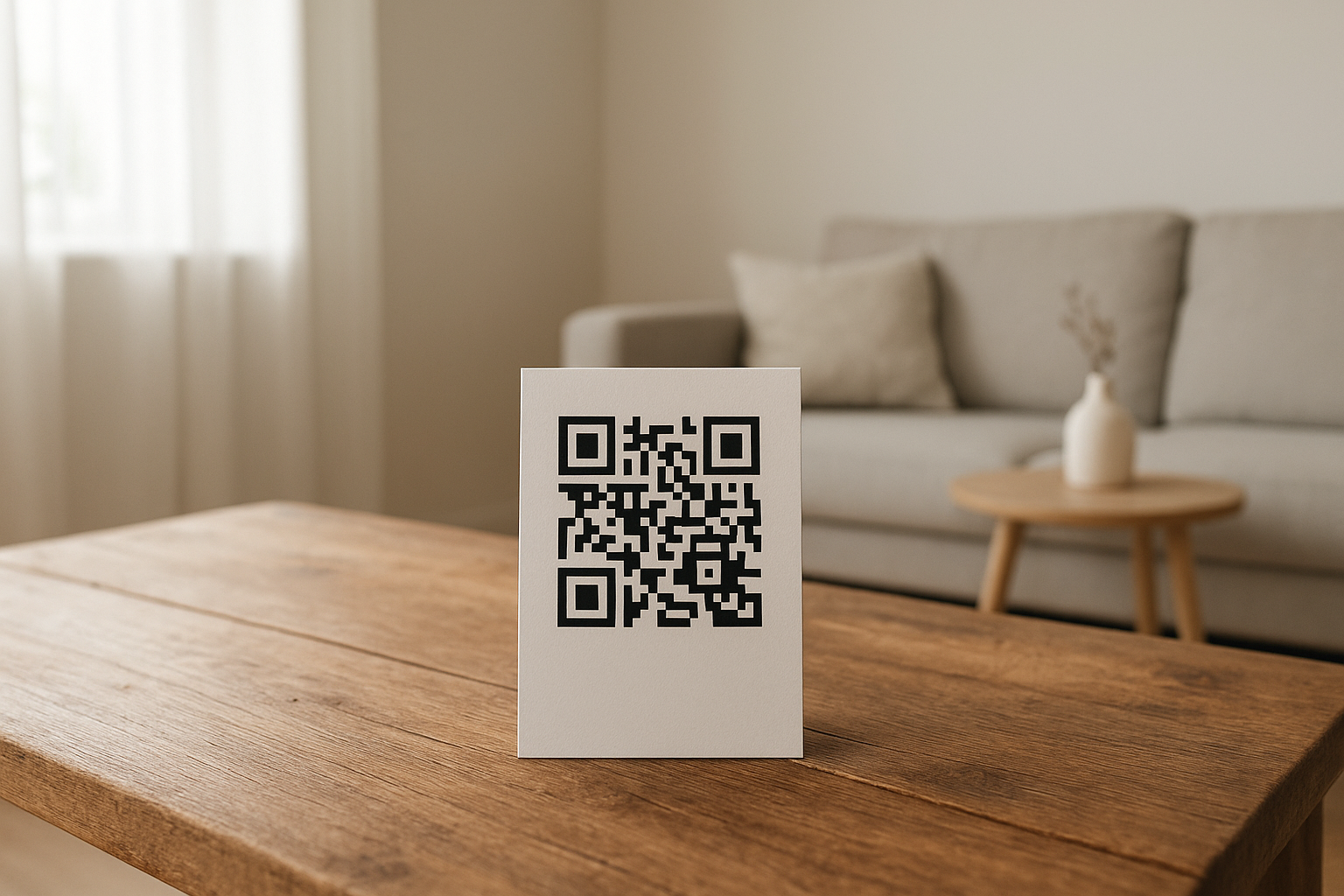
Short-term rentals often pair a short printed note with a QR code for anything that comes up later.
Frequently Asked Questions About Hotel Guest Welcome Notes
What is a hotel guest welcome note?
A hotel guest welcome note is a short written message, printed or digital, that greets a guest at arrival with a personal touch, key property details, and a point of contact for help. It typically mentions the guest by name and sets the tone for the stay.
How long should a hotel welcome note be?
A hotel welcome note works best at three to five sentences, short enough to read in under a minute. Longer notes tend to get skimmed or ignored, so property details belong in a separate guide instead.
What should a hotel guest welcome note include?
A strong note includes the guest's name, a warm greeting, one property-specific detail, and a clear way to reach staff. Many hotels also add a QR code link to a digital concierge for anything beyond the basics.
Is a handwritten welcome note better than a printed one?
Handwritten notes feel more personal but take staff time that is hard to find during busy turnovers. A printed card with one handwritten line, such as the guest's name, usually offers the best balance.
How do I write a welcome note for international guests?
Keep the written note simple and pair it with a QR code that opens a translated digital concierge. This avoids translation errors on paper while still letting the guest ask follow-up questions in their own language.
When should staff deliver the welcome note?
The note should be in the room before the guest arrives, ideally placed during the final housekeeping check. A note delivered after check-in loses most of its impact.
What is a good hotel welcome message for short-term rentals?
Short-term rental hosts should combine a brief printed note with a digital check-in guide, since there is no front desk for follow-up questions. A QR code connecting to an always-available concierge covers that gap well.
How much does it cost to add welcome notes to the guest experience?
Printed welcome cards cost very little, often under a dollar per stay in paper and ink. Adding a digital layer, such as a QR-based concierge, is typically priced per room per month rather than per guest.
What are common mistakes with hotel welcome notes?
The most common mistakes are generic templates with no personal detail, misspelled guest names, and notes that promise help but give no real way to request it. A note without a clear next step rarely gets used.
Can a welcome note mention food allergies?
A welcome note itself should not be relied on to collect allergy information, since paper notes are not tracked or acknowledged by staff. Allergy details are safer captured through a digital concierge that alerts the kitchen directly.
How does Cortesia help with multilingual welcome messages?
Cortesia lets guests scan a room QR code to get a welcome message, local recommendations, and service requests answered in their own language, with no app or login required. Staff see every request translated into the language they work in.
What is the difference between a welcome note and a guest app?
A welcome note is a one-time greeting, while a guest app or QR concierge is an ongoing tool the guest can return to throughout the stay. Most boutique properties pair a short printed note with a no-download digital concierge instead of asking guests to install an app.
What's the difference between a welcome note and a welcome letter?
A welcome note is short: usually three to five sentences on a card. A welcome letter is longer and more formal, often used for corporate bookings, group stays, or VIP guests who expect more detailed context about their visit.
Do welcome notes actually improve guest reviews?
Guests frequently mention small, personal touches in reviews precisely because they stand out against generic service. A hotel guest welcome note that uses the guest's name and a specific detail is more likely to be remembered and referenced positively than a note that reads like boilerplate text.
Final Thoughts: Make Every Hotel Guest Welcome Note Count
A well-written hotel guest welcome note still earns its place in the guest experience, even as technology takes over more of the stay. The key is keeping it short, specific, and genuinely personal, rather than a photocopied formality nobody reads twice. Whether you borrow one of the eleven templates above or write your own, the same four rules apply: get the name right, add one real detail, give a clear way to reach staff, and match your brand's voice.
However, a note alone cannot carry a multilingual, understaffed property through an entire stay. Pairing it with a QR-based concierge, like the one at cortesia.ai, lets the warmth of the written word extend into every language a guest might speak, without adding a single person to the schedule. You can also explore the root site at cortesia.ai for more hospitality resources.